
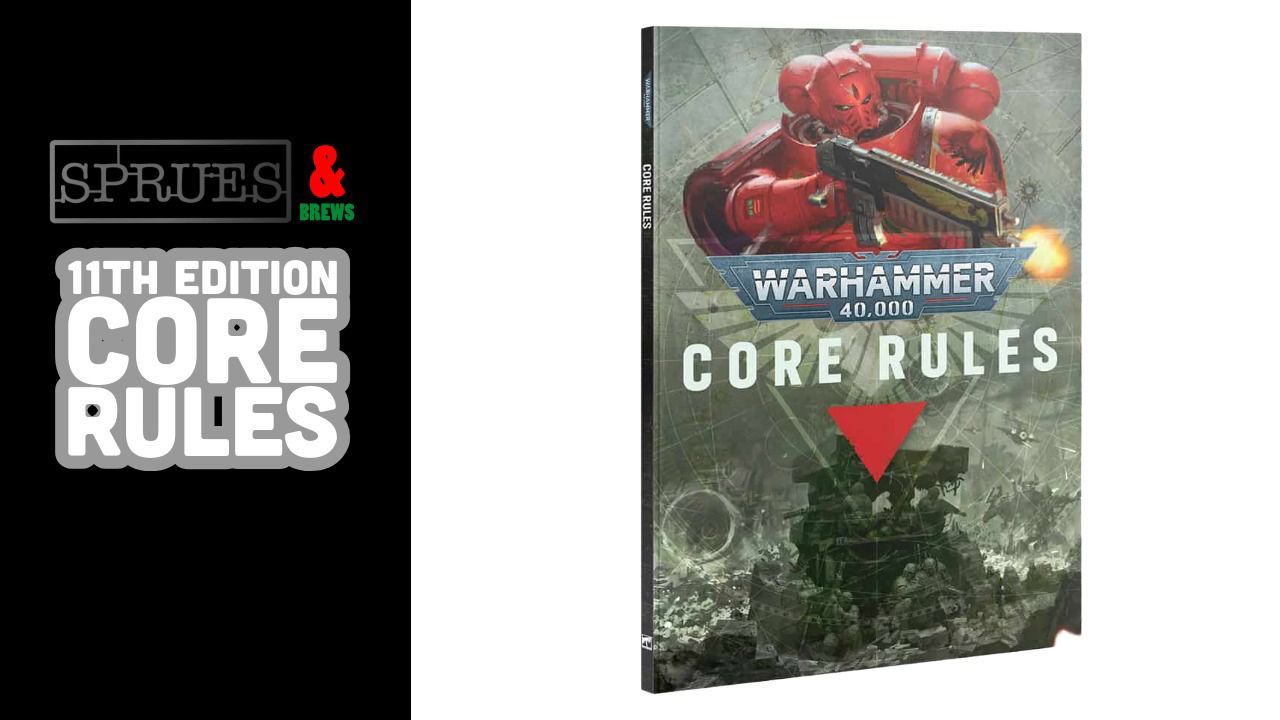
The new edition of Warhammer 40,000 has crashed onto the scene with the awesome Armageddon box, but that’s not the only thing we’re checking out as we also have a full review and deep dive of the brand new Core Rules for Warhammer 40k 11th Edition.
Contained in small format soft back in the Armageddon box, the Core Rules are also available for free online so you’ll be able to jump into the new edition yourself very soon! Faction Packs and Points will follow over the coming weeks up until the game is on the shelves, and we’ll be checking those out right here too!
Armageddon (containing the Core Rules) is up for pre order this Satuday 6th June and is released 20th June.
Massive thanks to Games Workshop for sending us over Armageddon to check out on the site. If you would like to support the site then why not order your Warhammer 40k 11th Edition goodies through our affiliate Element Games and save yourself some money too?
We’ve also got a video going through the new core book which you can see just below or over on YouTube
That’s not the only 11th Edition content we’ve got up on the site today – We’ve also checked out Armageddon, the Combat Patrol Companion and a look at the Chapter Approved, Dominatus and Area Terrain packs!
So without further ado let’s dive into the Warhammer 40k 11th Edition Core Rules
Warhammer 40k 11th Edition Core Rules Review

Can you believe it’s been 3 years already since 10th edition was released? Last time around the mantra was “Simplified, not simple” and this time we’re seeing revisions on those core rules without making every existing Codex unusable. Yes, your current 10th Edition Codex is fully 11th compatible (there are some new documents coming that errata any bits that need tweaking, but they are pretty minor) meaning that if you are a current player you can simply use your existing book along with the faction pack in order to hit the ground running until your new 11th Edition book comes along.
That’s not to say there are not big changes though – it feels that every phase has been given some love in the new Core Rules to make sure the game plays much better than it did in 10th (Which was a little wonky at times for me by the end of the edition)
One big thing that is different for those who like a physical book is that the Core Rules in the Armageddon box is a small format softback version rather than a large hardback book. I know some people won’t like this change as there’s something nice about a big book on the shelves – but from a gaming point of view it makes things so much easier to have a small and light book that can be referenced during games or chucked in a bag for tournaments.
The book itself is a nice format for finding stuff though. Core concepts are numbered through to 24 with a big number above the page number so you can just flick to the right section – and phases even have a symbol next to this number so you can spot it as you’re rifling through it. It seems that they have made the book as easy as possible to look through while playing a game – and while some stuff lives in the advanced section that I’d rather within that phase (Ingress moves for example) it is easy to find things during the flow of a battle.
So let’s take a look through each phase of the game and check out what’s changed.
Command Phase
The Command Phase in 11th Edition works much the same way as it did in the previous edition, but there is now a strict order to events. Players first resolve any issues that trigger at the start of the Command Phase, followed by both gaining 1 CP. It’s worth noting you gain CP after Start of Command Phase abilities – so there might be situations where you havn’t actually gotten your CP yet to react to something that happens at the start of the Command Phase. We then have Battleshock, which works the same way but with a big change – If you fail Battleshock you remain Battleshocked until you manage to make the roll. This makes a big difference and could result in some units being battleshocked for multiple turns, especially if you can get them within leadership reducing auras.
“Command Phase” abilities now trigger, followed by “End of Command Phase” ablities. Finally both players check to see if they have scored any objectives. This clear structure makes it much easier to track when exactly things happen with a clear ordering.
Movement Phase
Quite a few things have changed in the Movement Phase – for starters pivoting is no longer a thing. Models without a base simply rotate around their centre point and this no longer costs movement. Models with a base also rotate around the centre of their base – now things such as Knight may gain an inch or two movement by deploying in such a way that the rotation brings the front of their base slightly outside of a deployment zone for example, but over the course of a game this all evens out.
Coherency rules have also changed a little, with units now also needing to be within 9″ of each other. I’ve seen a few people panicking about this, but as its not “Wholly within” you actually get quite a bit of space as just part of each base needs to be in this bubble.
Models now have a 2″ (and 5″ vertical) engagement zone, meaning you have a much bigger area you can now control with a model. Of course, this also makes it easier to be charged (as you now just have to get within 2″ for a successful charge) so it is a bit of a double edged sword!
Movement is split into a number of different types in order to make rules interactions clearer – Units can remain stationary, make a Normal Move (worth pointing out here that Heavy Weapons now get +1 to hit as long as you move no further than 3″!), Advance Move (move an traditional D6 but not shoot unless you have Assault Weapons), Fall Back (this now causes Hazard Rolls if you are battleshocked – and Hazards now cause a Mortal Wound on a 1 or 2 now!). There’s also a couple of advanced options such as Disembarking or making an Ingress Move (This the new name for setting a unit on the board – generally from the board edge, but deep strike allows more freedom. You also now need to be over 8″ from enemy units, which combined with the 2″ engagement range makes it so that 7″ charges are needed from deep strike…).
Movement through terrain is clarified, with vehicles able to drive over terrain pieces as long as they have enough movement to make their way up and down them (though they cannot end on top of them, usually meaning it makes more sense to drive around them)
Shooting Phase
The shooting phase also gets some love in the new edition of the game. One of the big ones here is that there are different ways of modifying both BS and the hit roll, essentially allowing you to get +2 to hit if you are able to improve both of them. Equally though this also applies to when you are shot too! The best example of this is the fact that being in cover now causes whoever is shooting you to reduce their BS by 1 – And if you can get an aura or ability on them to reduce the hit roll by 1 then essentially you’re now -2 to be shot at which is great!
Positioning is more important than ever, and being on a higher level that your opponent now gives you +1 to your BS. Some units such as Knights now have the “Towering” rule which also gives them the same effect!
Terrain interactions with shooting are now a lot clearer and have finally hit the sweet point between realism and game mechanics – for example the bottom floor of any building now blocks line of sight in and out, but the floors above allow you to draw line of sight out of windows. Because there’s such a benefit to being higher, it means that in order to gain this advantage you also have to put them at risk – which is a nice trade off from a tactical point of view.
The 11th Edition Core Rules also introduces a new concept in “Hidden” units. An Infantry, Beast or Swarm unit that is in a piece of area terrain with Dense scenery (walls, structures, woods etc) gets to be classed as “Hidden” as long as they have not shot this or the previous turn. When Hidden a unit can only be seen when they are within 15″ – this goes a long way for making units sat in terrain a lot safer both in the first turn, but also late game when you manage to push into an enemy home objective – the enemy will now need to draw off forces in order to deal with them rather than simply being able to turn around and shoot them!
If you’re a fan of mortars, the new rules are pretty cool too! Firing blind, anything with indirect fire only hits a target on a 6. But in a cool touch, as long as your artillery is stationary and a friendly model is able to see the target then they hit on an unmodified 4+! This is very cool and represents your spotters radioing in the targets to your big guns! My Death Korps very much like this change!
Charge Phase
We’ve talked about charges now being easier with the extended engagement range – to make a charge you simply need to get into engagement and then the entire unit can fight. But charging has also improved in a number of other ways too!
Firstly, charging now works like in Age of Sigmar. You pick your unit, roll your charge and then if you want to you can move your unit into engagement range of any unit within that distance. So no more picking a target, you just roll and then move into the best target for you. What’s more you can even roll then decide that actually you don’t want to charge because you didn’t roll as far as you wanted. This is going to make close combat armies really good and give them a lot more options compared to what they had previously.
Fight Phase
So you’ve managed to make your charge, but now what happens? Well, pile in has changed a lot – rather than doing a pile in move in turn when you pick fights, everything piles in at the start of the turn. Starting with the active player they make all their pile in moves, and then the opponent does the same. This makes sure that Pile In is used to get as many people into combat as possible rather than just being a way of cheesing onto an objective or forcing the hand of the enemy player – with everything moving at once it’s much easier to see the lay of the land before you start rolling dice.
Another change that goes in the favour of close combat armies is the fact that the charger picks units starting with their fights first and also picks the first unit once all of them are resolved too. This makes it less of a liability to leave a unit in combat multiple turns as otherwise your opponant always had a chance to hit you back first in an extended fight.
Combat sequencing has also been simplified with some elegant new fast rolling and unit declaration rules. Majority toughness is still used when fighting targets consisting of multiple attached units, but now the owning player declares the order that those units want to be allocated wounds. Characters still take this damage last, but you declare the order you want to try and save them before you make the save roll. So say for example if you had an infantry unit of 5 models with a 4+ save with another attached unit of 2 models (using the new support keyword) with a 2+ and a hero with a 3+ save you have to pick the order that they make the saves. The hero has to be last, but you could opt to take the saves on the support unit before your grunts get hit. In this scenario you roll the dice for hits you take and start allocating saves from lowest to highest – say you roll 5 dice and get 1, 1, 3, 4, 5
The ones get allocated first – you picked the 2+ save body guard and so they are both now dead. Next the 3 gets allocated to your grunts and kills one, then the 4s get allocated (which you save) and the 5 gets allocated (which you also save). This is really elegant in practice and stops you having to roll dice in groups because of different save rolls.
After all fighting has happened across the entire battlefield both players now get the opportunity to make consolidation moves. Just like with pile in, the active player goes first followed by the other player, and there’s now a clear defined structure to what you can do with them – essentially if you can go towards a unit within 3 you have to move into them, otherwise you head towards the nearest objective. Again this stops any funky things that happened with these moves and makes sure things make sense narritivly too!
Objectives
One of the biggest changes in the new Core Rules is the fact that Objectives are no longer arbitrary circles that the forces are fighting over, objectives are now key locations on the battlefield – a critical building perhaps, or a downed lander. Each objective is a piece of area terrain of a defined size and represents an area of importance on the battlefield. I really like this change as it adds a lot of flavour to things – units are now fighting over buildings, tanks can roll into ruins to try and contest them against the infantry holding them off. That pile of crates isnt just something to hide behind, it’s something being fought over.
Of all the changes in 11th this is probably my favourite and I’m looking forward to seeing more of the upcoming pre painted terrain as it’s going to make it much easier for everyone to have gorgeous looking battlefields to fight over.
Stratagems
Like with most other things in the game, Strats have also had a bit of a revision in the new Core Rules. Most importantly a unit can only be affected by one stratagem per phase. So no longer can you stack up multiple strats on a single unit, and you’re going to have to decide if you want to use an offensive, defensive or a reroll strat as part of the strategy in 11th edition!
The strats themselves have also had some tweaks. Crushing Impact is the new Tank Shock, and finally your monsters can do damage when they charge! This is a brilliant change, but dont forget if you use a CP to reroll a charge you’re not going to be able to use this due to the once per phase limitations!
Fire Overwatch now happens just at the end of the enemy movement phase, they move all their units first and then you can pick one of your units to shoot any units – it doesnt have to be one that’s moved either!
Smokescreen gets a cool new rule, your friendly units behind a tank that has popped smoke also get the benefit of cover, which really feels right with infantry units hunkering down behind a vehicle that’s launched its smoke!
Heroic Intervention also gets a cool twist – normally you can only charge into a unit that has charged this turn, but if you pay an extra command point you can instead go into any unit! There is a maximum range of 6″ if you do this however!
Attached Units
Previously in 10th Edition, normally only one unit could attach to a unit – but there was a load of exceptions where you could add additional ones, and it was very messy with all these being listed on the unit profiles.
In the 11th Core Rules, this has been cleaned up by allowing every unit to have a Leader and a Support unit attached to it. These will be listed in Codexes going forward, but there will be documents for every faction listing any updated rules such as these. From a combat point of view you’ll always use the highest toughness of the bodyguard units first, and once they are dead you’ll use the highest toughness of the remaining characters.
As before, all keywords are shared – but now any buffs now apply to units even if they are not attached to another unit, which is a much wanted change!
Flying and Aircraft
Both flyers and aircraft have had a big change in this edition! Flying units can now move over enemy models and terrain when moving or charging at the cost of -2 from their maximum movement. So for example if you had a unit with Fly with a movement of 14 then they could opt to move 12 inches in order to be able to move over things. If they charge then their maximum charge is 10 regardless of what they roll (it’s worth noting here its not -2 movement, it’s -2 to their maximum move)
Units with Hover get to ignore this rule however and can move as far as they can normally!
Aircraft also get a fresh pass in the new edition. They now no longer have movement and can only make ingress moves. This means they are placed within 6″ of any battlefield edge (can only go in the enemy deployment zone in turns 4 and 5 however) and are ignored by all other models for the purposes of movement. They can be charged and fought by flying units. Once the enemy turn is over they fly off the board and go back into reserves ready to pop down on any edge the following turn!
I really like this and I feel it’s going to be a lot easier to bring aircraft now – while this does mean they will only ever pop up around the edge of the board, there’s lots you can do here to get into decent firing lanes etc.
Core Abilities
With so much changing in the Core Rules, a lot of Core Abilities have also had a fresh pass in the new edition. Blast for example now has a multiplier – so for example a unit with Blast 3 would get 3 additional shots for every 5 models in the unit, allowing these to scale much higher. Cleave is a new rule that is essentially blast for close combat. Now there can be weapons that are even better when sweeping through a large unit rather than just being a long drawn out meatgrinder.
Hazardous is now more, um, hazardous. A roll of 1 or 2 is now a mortal wound on the target, or 3 if you’re a hero or monster – making it quite easy for a hero with a hazardous weapon to accidentally blow themselves off the board!
Psychic attacks are now a lot more reliable and can now ignore all hit, BS and WS modifiers, making them much more accurate in an addition where you can potentially be -2 to hit due to combinations across these!
Summary
I’ve been lucky enough to play quite a few games of 11th Edition now, and it feels a lot more refined than the previous edition of the game. A lot of the stuff I didn’t like about late 10th Edition came from the tournament mindset and people stretching rules to their limits to do cheesy things. It feels that the team has done their best to close a lot of these loop holes and keep things feeling much more narrative and more like a battle rather than 4 turns of units hiding behind buildings before jumping on disks to win the game.
While still using the core of 10th edition, there’s actually a lot that’s changed here in the Core Rules and the game is much better for it! Units now get benefit from scurrying into higher floors of buildings while putting themselves at risk from incoming fire, other units can hunker down in a location, undetected until they need to commit to the battle, while aircraft now strike down on bombing runs and surgical strikes. Combat armies now hit hard and have more reliable charges, where immersion breaking things such as conga lines are now a thing of the past.
11th Edition has been a breath of fresh air after a 10th edition that has gone through a lot of revision and adjustment, and I can’t wait to see what is in store for us in the upcoming Codexes.
Warhammer 40,000 11th Edition is up for pre order on the 6th June and will be released Saturday 20th.
Games Workshop provided Sprues & Brews with free copies for review purposes.

Leave a Reply