
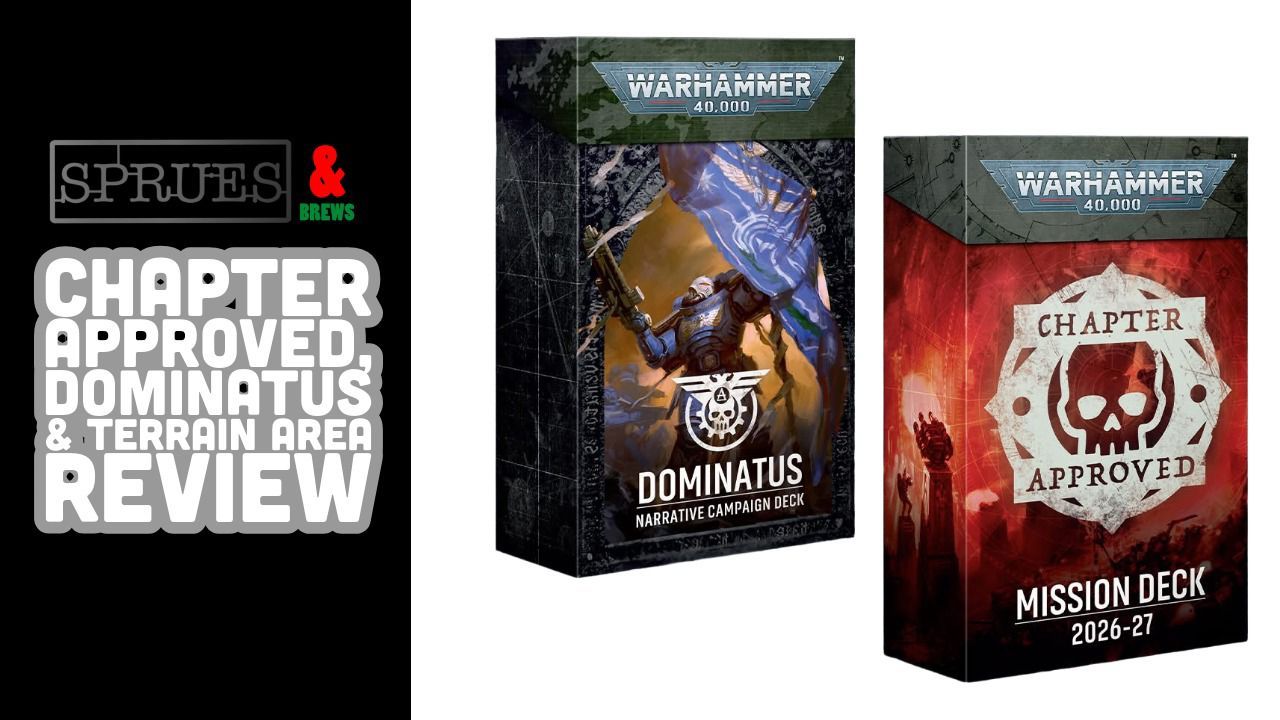
The new edition of Warhammer 40,000 is nearly here with the awesome Armageddon box! But inside the box are two card decks – Chapter Approved and Dominatus. In this review we’ll be taking a look at what those decks are and talking about how exactly they work in the game!
Alongside the Armageddon box, Games Workshop are also releasing a Terrain Area Set too, giving you the footprints you need for your games of Warhammer 40k. We’ll be taking a look at them and seeing if they are worth picking up!
Massive thanks to Games Workshop for sending us these over to check out on the site. If you would like to support the site then why not order your 40k goodies through our affiliate Element Games and save yourself some money too?
We’ve got a whole stack of 40k articles up today with our review of Armageddon, a deep dive into the Core Rules and a look at the Combat Patrol Companion all up on the site today!
We’ve also got a full unboxing video checking out these card decks which you can see just below or over on YouTube
So without further ado let’s check out what’s in these decks!
Chapter Approved Review

If you’re a long time 40k player then you’ll know the name Chapter Approved. Originally a series of rules in White Dwarf that gave players experimental and new rules to use in their games, Chapter Approved was later the name of a series of annual books that gave 40k players new missions and scenarios. In 10th Edition these books instead became card decks that had deployment maps and primary and secondary objectives that could be generated over the course of the game.
In 11th Edition Chapter Approved has most of that DNA, but this time round Games Workshop have done some really interesting things with army building that lead to a more narrative experience even in Matched Play games.
When building your army in 11th Edition you have a number of Detachment Points available that can be used to purchase detachments. Each of these detachments has rules that affect how the army operates and improves specific groups of units – but new in 11th is a new concept “Dispositions”

These fall into one of 5 catagories – Take and Hold, Disruption, Purge the Foe, Priority Assets and Reconnaissance.
Every detachment is assigned a Disposition, and when playing a game you pick one of the dispositions that are marked on detachments you have taken in order to generate the missions you will be using that game. Each of these essentially represents how the army leans into operating. Purge the Foe is generally about killing units, Take and Hold is geared towards taking objectives, Disruption is about doing actions in enemy territory, Reconnaissance is about surveying units and triangulating the locations of objectives through actions while Priority Assets gears into reacting to be able to take objectives and perform actions in specific locations. All are subtly different and are geared towards different types of armies.
What’s really cool with this set up is the fact that the misson you play is determined through a combination of what your Disposition is, and your Opponents. So for example if you are Take and Hold you would play a different mission against a Reconnaissance than you would against a Purge the Foe player. These missions are asymmetrical with both forces trying to do something that is in line with their playstyle, but also makes narrative sense from the two forces that are facing each other.
This is a really fun way of doing things that gives the mission some story rather than both sides just trying to stand in circles for 5 turns.
My only concern with this is that if you only have a small gaming group or a single opponent that you could potentially be playing the same scenario over and over, however as your army is made up of multiple detachments there’s always the potential for you to pick a different disposition in order to mix things up, and deployment maps are randomised every game too in order to give you a different layout. Games Workshop will also have a document of suggested terrain layouts to use for each mission – but the card deck also has rules for creating your own layouts too.
Random secondaries are still a thing in Chapter Approved, but this time you get two cards a turn and can keep ones you have gained in previous turns. There was nothing worse than picking up a card way too early previously – but now as you get to keep all your cards you can simply score it later in the game, which is a great change.
I’ve played a number of games using this deck, and against different armies have had very different experiences due to the primary changing based on the disposition matrix, which is very cool! I really hope this is something we see grow and develop through future Chapter Approved decks.
Dominatus

One of our favourite things about the last few editions of the game has been Crusade. This was a narrative system that allowed you to “level up” your units, earn unique relics and basically tell a continuing story with your army. It was however basically a different game mode, and it had different missions, objectives and took a lot of book keeping.
In 11th Edition 40k it seems that Games Workshop is trying a different tactic for Narrative Games this time with the Dominatus deck. This deck is basically a self contained narrative event weekend. If you’ve ever been to a narrative event at Warhammer World then you’ll know its a great way of playing a linked series of fun narrative games that tell a story that is affected by how the games go.
Dominatus takes the essence of that and turns it into a deck that lets you replicate those type of events with a group of people.
A single person (known as the Warmaster) will coordinate things and be in charge of proceedings – you really need someone to be able to do this as there are more moving parts than a normal game of 40k.
Players will then be split into 2 or 3 different groups depending on how many players you have. The Liberators are the brave armies looking to break the invasion of Armageddon. The Oppressors are those who are there to destroy Armageddon adn the Raiders are the piratical types looking to take advantage of the chaos!
Once the groups are split up, each is given a card that tells them the narrative so far – this is really cool, and it actually uses the disposition system from Chapter Approved to add some narrative reasons as to why you are fighting the army you are facing.
In comparision to Crusade, this deck uses Chapter Approved itself for the games you will be playing – Dominatus just adds the narrative frame work around that. Depending on the results of your battle you might gain powerful Battle Honors due to winning the game, but even if you lose you’ll gain Battle Skills that can be used to enhance your units. Win or lose, the outcome of the game will have it’s own narrative card that tells you what has happened from a lore point of view, and award you a number of narrative points that impact the overarching campaign.
These battles continue over a number of different phases. The set recommends playing 5 games over the course of a weekend, with the first 2 being the first phase, the 3rd and 4th game being in the second phase and the final game being the cinematic showdown. There’s different cards for each phase, meaning that over the course of the weekend you shouldn’t hit the same narrative beats but will instead have crafted your own shared narrative over the course of 5 games.
Things you have earned in each battle can then be equiped by units in future games, giving you an evolving army over the course of the weekend.
This is basically a way of adding a narrative flavour over a short run of games – but there’s nothing to stop you taking these rules as a foundation and expanding them out further in order to have the campaign run for a month for example with a map and more depth. The rules encourage you to run this your own way, but they real key here is that it works great just out of the box, and because it’s all driven using the Chapter Approved deck it feels like you are playing “proper” matched play 40k while still getting all the fun that comes with narrative play.
I’m really interested to see how these sets evolve and if future Codexes will have any Crusade content or if decks like this will replace it going forward.
Terrain Area Set


Before we close out this review though, there’s just one more release we want to take a quick look at. Priced at £18.75 the Terrain Area Set gives players a full set of double sided Terrain Area tiles that are used to show the outlines of your terrain on the Battlefield.

16 Matte Area Terrain tiles are included over 5 different designs. All of them are double sided increasing the number of different layouts you can make and they work really well over lots of different battle mat designs. In the above image I’ve got a desert board which is a good colour match, but they don’t look odd even on things such as grass battlefields. Though I do hope we see more designs of these in the future.
Once these templates are on the battlefield you are then free to use whatever terrain you have in your collection to bring them to life! Again, Games Workshop will be releasing some suggested layouts for events but there’s nothing to stop you using your own ones.
At £18 I think these are well worth picking up and makes identifying when units are in terrain a lot easier – plus they look a lot less immersion breaking than the old objective disks, something which always took me out of the game a little!
Massive thanks to Games Workshop for sending us these over to check out on the site. The card decks come in the Armageddon Set (but will be available individually too) and the Terrain Area Set is up for pre order at the same time. Pre Order is Saturday 6th June with a release date of Saturday 20th June
Games Workshop provided Sprues & Brews with free samples for review purposes.

Leave a Reply