
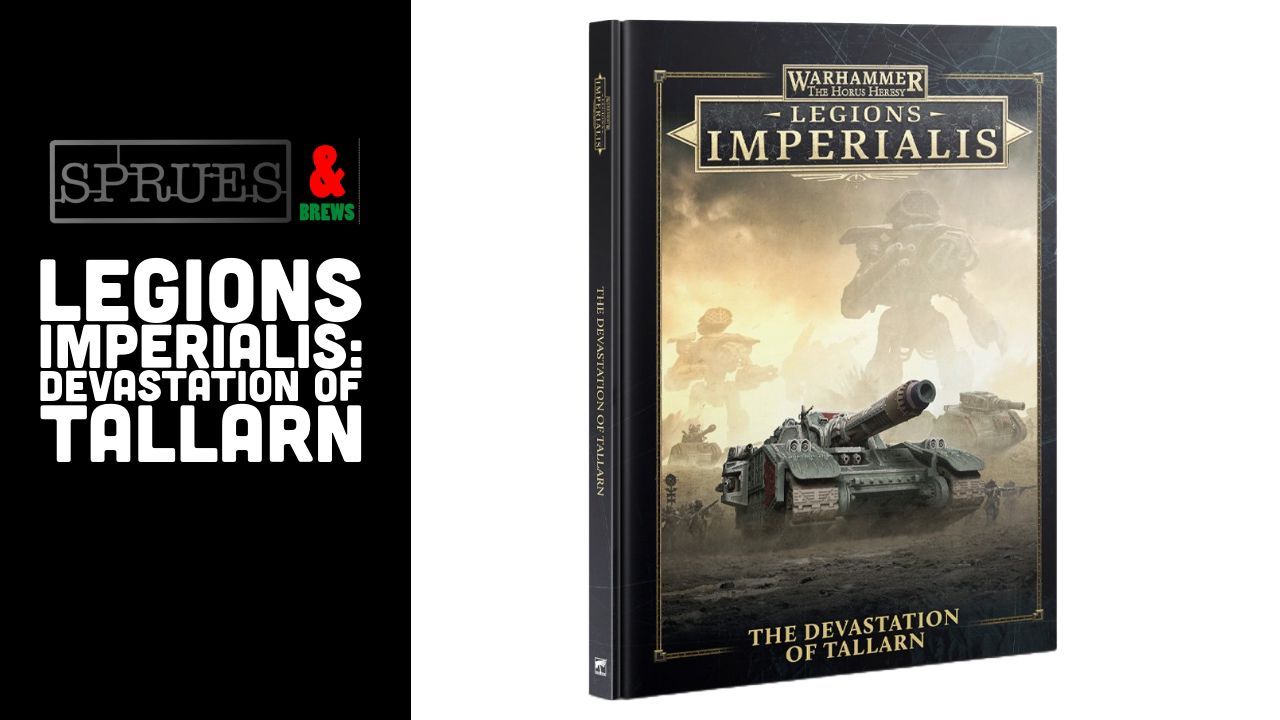
During the Horus Heresy the world of Tallarn, once a vibrant and verdant green world, was subject to utter devastation at the hands of the Iron Warriors. Virus Bombed to replace the atmosphere with a toxic fog of sickly brown rot, the world was soon engulfed in mass combat with entire detachments of tanks and titans striking out against each other. Soon the world would be littered with the corpses of blown out vehicles, as the virulent fog slowly choked out the world.
In Legions Imperialis: The Devastation of Tallarn, up for pre order today, players are able to not only recreate the Tallarn campaign with some awesome new campaign rules and missions, but are also able to expand their Legions Imperialis armies with new formations and detachments for both the Legiones Astartes and the Solar Auxilia.
In this review we’ll be taking a look at the contents of the book, seeing what is added and checking out what cool new things can be added to your Epic armies!
Massive thanks to Games Workshop for sending us a free early review copy to check out on the site. If you would like to support the site then why not order your Legions Imperialis goodies through our affiliate Element Games and save yourself some money too?
So let’s head down to the virus chocked skies of Tallarn to see what goodies are in the pages of The Devastation of Tallarn
The Devastation of Tallarn Review
If you’ve picked up the previous Legions Imperialis campaign book The Great Slaughter then you’ll know what to expect from the makeup of this book. Over 122 pages we get lore about the battle itself, a comprehensive section detailing some new campaign rules and finally new formations and detachments for games of Legions Imperialis.
The first 55 pages covers the history of the battle for Tallarn, and this is done in a great style reminiscent of the old Imperial Armour books. We get histories and events, full army breakdowns of units present and a full and detailed breakdown of the battle for the Sapphire City with battle report style maps showing the movement of units. This was a great read and sparked ideas for campaigns and games of my own, with some ace moments that would make for a suitably cinematic series of games!
What’s really cool in this section too is that we get some “in universe” excerpts from the Divisio Munitorum detailing the tanks of the Legiones Astartes, how they are suited to different roles and how the different Legiones Astartes use them in battle. I love stuff like that that adds some real flavour from a lore point of view, and find these sort of in universe accounts go a long way to the feel that this is a historical document detailing battles that took place in the fictional history of the 40k universe.
Campaigns
One of the biggest things that this book introduces is an assortment of new campaign rules that build on those in the core book and the previous supplement – As you can imagine by the setting of the book, a large focus here is on tank battles and stronghold sieges, and there’s some really fun stuff available here!
First off we get a new Breakthrough campaign – This is a campaign designed for 6 players, with 3 Loyalists and 3 Traitors (Through it is possible to increase this by a couple of players on each side, but it does recommend no more than 5 a side) with the campaign representing two opposing strongholds sending out waves of troops along 3 different routes – the campaign itself represents the back and forth of the forces along a route until one side eventually breaks through to the stronghold. This is a really exciting campaign structure as even if one of your routes is performing badly, perhaps someone on your team is managing a successful push through to the enemy stronghold and putting a lot of pressure on the other side. A campaign map is created with 3 stages along each of the 3 routes and a stronghold at either end – 3 markers start in the middle of the map, and as battles are won they advance further along the winning side’s route until they reach the stronghold. Once at least 2 markers are on a stronghold then the winning team can launch the big cinematic Stronghold Assault mission to try and win the campaign. Fail, and the marker moves back a step allowing the other side to try and get a push.
The Stronghold Assault itself is a cool mission with a perimeter wall (with working gate) that spans across the board and the attackers must breach – objectives are inside the wall, so bringing things such as Titans and other super heavies that can breach them is going to be needed here. The gates are a little weaker than the wall, but can be opened to allow the defenders to sally forth and take the fight to the attackers, with the obvious weakness that an open gate is much easier to breach than a closed one! The gate itself is an objective, and once someone has control of it they can choose to open or close it at the start of each round.
I really hope we get some official terrain to be able to do this with, though I know a lot of third parties do some great wall and gate scenery sets, and I can see a lot of Beach the Stronghold bundles being put together to take advantage of the demand of this mission type!
We also get a full pre-written Breakthrough Campaign – this gives each of the three routes different special rules to represent the environments that were fought over on Tallarn, so for example the Sapphire Basin is where the worst of the fighting took place, and it is littered with a Titan graveyard, making all difficult terrain into dangerous terrain (Bonus points if you have scenery to best represent a titan graveyard!) or the Khedive Plateau, which is covered in trenchlines and fortifications making all cover saves one better than normal. These are small special rules but add some flavour to represent the battlefields that you are fighting over.
Campaign Expansions
Like with the previous book, we also get a variety of Campaign Expansions that aim to add additional rules and features to games to mix things up. One of these are Campaign Rosters – this is a roster of 4000 points of detachments that can later be formed into formations when making army lists for games – essentially this gives you an expanded pool of models to draw from when making your lists and means that if you take a nice mixed assortment of units in that initial 4k, over the course of the campaign you’ll be able to put together some nice varied lists rather than each player having similar units each game. In addition to this, over the course of the game you also get access to requisiton points that allow you to add additional detachments to your formations – essentially giving you a resource to spend as extra points in certain games based on the flow of new units to the battle zone.
Another new thing added are Victory Boons – these give the player that wins the previous game a bonus in their next battle – they roll a D6 and one is generated randomly, or the campaign master can select one based on the narrative and heroics of the battle that just happened – these can range from units gaining Forward Deployment for the next battle, or allowing them to do a pre-game bombing run for example – again, these give you a nice little reason to win the battle and gain the upper hand in the next game
Tallarn was covered in toxic fog, and the new book actually contains some cool rules to represent the effects of the Fog of War in your battles – firstly deployment is hidden – this will take a little setup, be it a sheet draped across the battlefield, or a series of box lids standing up to obscure view. This is something I actually did back with my brother back in the mists of time to make games more exciting by making it so that you don’t actually know where the enemy is going to be.
If setting up a screen seems a bit of a faff, it actually has another suggestion of writing the names of your detachments on small pieces of paper and “deploying” these face down on the board – you know where units are, but you dont know what they are until they are all flipped over before the first turn and the models are put in their place.
In addition, Fog of War games have limited visibility with much reduced ranges, and there’s a chance that infantry models take damage each turn from being exposed to the deadly fog. While this probably isnt something that you’d want to use for every game of LI that you play, it does add a nice twist that adds a lot of flavour.
Spearhead Assault is a new game mode introduced in the book – Much like the previous book had rules for battles with just Titans, Spearhead Assault is designed around armies of armoured vehicles and introduce victory conditions for destroying units scale 2 or bigger – full rules are included here along with 3 unique scenarios that are suited specifically for tank battles. Interestingly, there are no restrictions on list building here, meaning that you could technically bring infantry without transports if you wanted, but I feel the intent here is for a framework for games where you want to represent the massed vehicle battles of Tallarn, so a little self policing is needed to ensure that you are using lists that keep the theme of this and make sure all your units are tanks or inside transports!
Battle Honours is another new addition to the game, that allows you to purchase “veteran” units that have some additional rules. Each player can pick a detachment and pay additional points in order to give them a battle honour ability. There are tables here for Infantry, Walkers, Cavalry, Vehicles, Knights and Titans with 3 different abilities able to be selected. As it’s only a single detachment in your army that gets this, it isnt particularly over the top, but does give your the opportunity to represent particular famous or heroic units that you want to tell your own story with – So many your Leman Russ detachment is particularity skilled at obscuring their rear arc when advancing, stopping the enemy from gaining that bonus, or maybe your Titan has expert Enginseers onboard allowing you to reroll the dice to reignite void shields. There’s lots of choice here and a nice way of using some spare point to make a vet unit.
Formations of Legend
Another new thing introduced in he Devastation of Tallarn are Formations of Legend – these are pre constructed formations with fixed builds (Each as a standard one with the base units filled, and an expanded set of detachments that can be added) – you lose the flexibility of taking whatever you like in the formation, but you get access to some extra special rules – so for example the Iron Hands Seeker-Killer Clave is made up of units of Sicarans and Sabres with the Macro-Extinction Targeting Protocols, or the Alpha Legion Harrow Group has units of Plasma Gun Support in Land Raiders with supporting Sicarans and Sabres, all able to Scout and Outflank. 5 Formations are introduced here (With a tank heavy theme as per the book) and I fully expect more of these to be added in future!
They are pretty fun and thematic, and actually work quite well as building blocks of padding out a larger army, as due to the fixed points cost they are quite expensive.
New Formations and Detachments
Like with the previous book, Devastation of Tallarn comes with another wave of brand new models along with their detachment rules and some new formations to place them in.
For the Astartes we get:
Sicaran Punishers – armed with 4 dice Ap 01 Light AT and Rapid Fire Punisher cannons, short range but reliable with a hit value of 4+
Sicaran Arcus – these have a little more punch with an AP of 2 and anti tank, with the option of firing with skyfire and tracking if you sacrifice the hit down to 5+
Sabres are fragile but very quick at movement 11″ and the nimble special rule – armed with their neuron blaster they can decimate things at close range with AP 3, Shock Pulse and Anti Tank, alternativly you can swap this out for an autocannon with more dice and longer range but less hitting power.
The Astartes also get access to 3 new tank commanders that can be taken in place of a HQ slot – you’ve got options of Predators, Sicarans and Kratos here, allowing for a range of roles.
Finally for the Astartes we finally get the Termite transport, allowing another flavour of deep strike to your army!
We also get two formations – The Legion Heavy Assault Spearhead is a fun one with 2 compulsory Terminator Detachments that must be in Spartans or Land Raiders, 2 Compulsory Dreadnought or Leviathan detachments, 2 Optional Battle Tanks, 2 Optional Heavy Armour and a Air Support – this is a nice one that allows you to lean into heavy armour for a nice looking Iron Warriors army for example
We also get a Subterrainean Assault Formation which needs a HQ, Support and 2 Core and an optional 2 Support and 2 Core which all get to be mounted in Termites – this formation has a really cool that has nearby units suffer the effects of quake once the deep strike is completed.
On the Solar Auxilia side we get a trio of new Super Heavies – The Shadowsword, Stormsword and Stormblade. All three of these can be built from the same kit, and cover a range of different roles from titan hunting, to demolishing vehicles or the swiss army knife Stormblade. I’ll certainly be picking up some of these to add to my force as I really want to do a full tank company
Speaking of tanks, we also get access to the rest of the Leman Russ variants – the Executioner, Demolisher, Annhiliator and Exterminator. Again they have a range of roles allowing you to put together quite a varied and efficient tank company.
As you can imagine, both of the new detachments revolve around tanks, the first is the “Titan Hunter Company” which consists of 3 compulsory Shadowswords, plus 2 optional Heavy Armour, and gives Shadowswords with a first strike order the Accurate trait when shooting at a titan!
The second is the Leman Russ Spearhead, this consists of 3 compulsory Russ detachments, plus optional light armour, battle tank, heavy armour and air support – which really helps to cram in as many tanks as possible.
Both of these formations require you to upgrade a single model to a Tank Commander.
There’s some really fun stuff here and as more expansions are released we’re seeing lots more types of army that are possible to put together.
Summary
Once again, Legions Imperialis is going from strength to strength with another fun book that not only contains some awesome lore, but also has an excellent looking campaign system and some much wanted additions to the range. My only criticism for LI at the moment is that we’re going to soon reach the point where in order to play a game you’re going to need to bring a small library with you – though that is somewhat countered by the availability of the stat cards, which give you a lighter option to take to games. At some point I suspect we’ll get a full “codex” for each faction – but until then you’re going to want to bring a bigger bag along to events.
Book bloat for unit rules aside, this is another great addition to the Imperialis library and I’m very much looking forward to playing through the new campaign!
With the Mechanicum now out for Heresy, hopefully it’s not long till we see tiny robots too…
Legions Imperialis The Devastation of Tallarn is up for pre order today and is released Saturday 17th August
Games Workshop provided Sprues & Brews with a free copy for review purposes.

Leave a Reply