
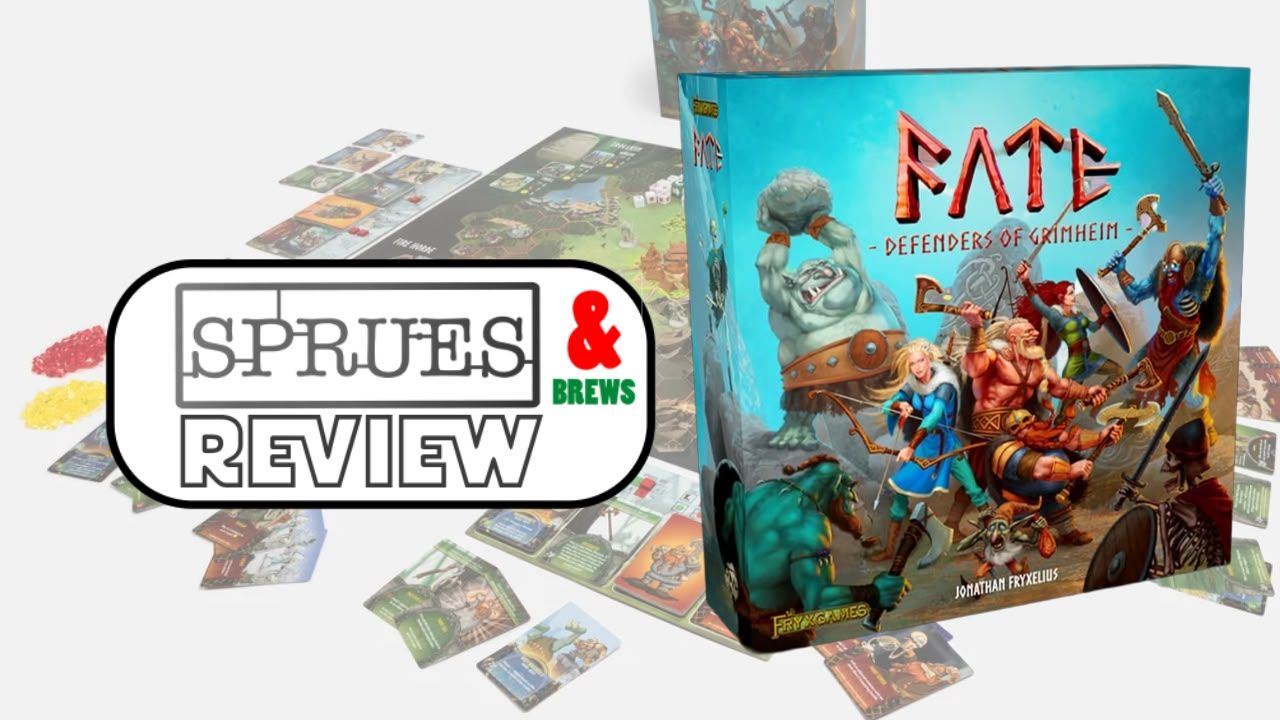
In Fate you don’t play one of the great heroes, they have all gone off to a massive party at Asgaard! Anyone who is anyone has gone to the wedding, so the players – the lowly inexperienced and unproven warriors of Grimheim have been left to defend Freyja’s Sacred Well! Unfortunately, Loki has taken this opportunity to destroy the well by unleashing unending waves of trolls, the undead and fire monsters upon the settlement!
In this full review we’ll be checking out Fate, having a look at all the contents and deciding if this one is worth picking up for solo players as much as it is for multiplee players!
Massive thanks to FryxGames for sending us over a copy for us to check out on the site. If you would like to support the site then why not pick up your board games through our affiliate Element Games and save yourself some money too?
Most people will know FryxGames from their mega hit Terraforming Mars, but Fate takes things in a very different direction to the colonization of Mars with a really thematic and flavorful tower defense board game based on Norse mythology.

This is one of those games that’s easy to learn but takes some time to master and there seems to be influence from tower defense video games as the premise itself is pretty simple to understand.
You the players each control one of 4 non-heroes and use them to defend the village from the oncoming waves of enemies. The game starts with a number of plastic buildings in the centre of the board, and if an enemy hits the village then one is removed. Once all the buildings are gone the players lose. In order to win, the players have to defend the village until time runs out, but as the game progresses more and more waves of enemies will march down the roads towards the village!

These enemies are represented by tokens, and in a really good move each of the enemy creature races have a different shaped token, and each of the three levels of creature within each race has a different size of token – making it really easy to eyeball the threats and find the correct tokens without having to search through a pile of identical ones. Each of the tokens shows the stats of the creature, but these are also clearly indicated on the board with large text too – which is massively appreciated by those of us getting older with worsening eyesight!
The number of creature waves that comes at the players is scaled by player number, and so the game stays as tense and exciting with 1 player as it does with 4. Of course with 4 players you have a wider range of options open to your in order to deal with the creatures, but you are also fighting 4 times as many.
A two player game took us about an hour to play through, and the game states that it takes around 30 mins per player – which feels about right, but I’ve not played this at higher player counts which might slow things down a little from the volume of tokens and cards out on the table.
This game doesn’t take up a massive footprint however, and you could easily get a 4 player game fitting around a standard dining room table – though as players start to level up you will need a little more board space for all your cards.


Where Fate really shine is the advancement and card system in the game. From a lore point of view you are inexperienced warriors, but over the course of a game you will develop your skills by sending experience, acquire new weapons and gear and complete quests in order to add interesting abilities to your toolset. If there’s skills that you like you can even invest into making those skills better to have your character focused on a particular discipline, or pick up a wider range of skills in order to cover more bases during a game.
There’s 4 different characters in the box (and I wonder if there will be expansions down the line that add additional ones) that cover a range of archetypes. We played as the Dwarf Boldur who was a bit of a tank who could soak up damage while being able to cleave his axe through multiple enemies a turn and Alva the archer who was excellent with her ranged attacks and had tricksy ways of locking down specific creatures and stopping them from moving.
The players have a number of resources they are trying to manage too – Mana fuels a lot of abilties, damage is gained on wounded warriors and can be healed, and experience is spent to upgrade and purchase skills. Theres different ways these can be earned too, from using an action, to defeating enemies to even venturing across the map to try and earn these resources.
In addition to simply trying to fight them off, you have cards that are unlocked by achieving a specific goal – this could be something like moving across a certain number of mountain tiles, or paying a number of resources on a particular type of space. These will leave you with a decision of trying to stay in the most favourable space from the point of view of defending the village and maybe taking a turn to try and achieve a quest and advance your skills and gear.
Advancement is something you’re going to want to do though, as without the better skills and gear it’s going to become harder to fight the waves of creatures that are heading into the centre of the board. And things can get hard really quickly if Fate decides to play you a bad hand. Each wave of enemies is determined by a card that show in what location and what types of enemies are set up, but sometimes you will spawn a particularly tough named enemy who is a real challenge for the characters to fight!
Monster actions are pretty interesting in that they have a predictable pattern until they get in range of the village. Each monster place has a direction arrow near it that shows the initial path of a monster, but once they hit a road they will follow that road until they hit the village. This means that players can work out the path of the creatures for the next few turns – However the game adds a wild card in the form of the monster dice. This could cause creatures to move faster, become stronger in combat or even push the players back a space. My favorite touch however is the two maneuver icons though – one Clockwise, one Counter Clockwise – these cause the creatures to rotate around the players, and this can lead to them leaving their predetermined path and instead moving directly into the village itself!

We had a close fought game where we were down to our last few buildings because of a sneaky goblin managing to sidestep past us and into the village to burn down one of our precious few remaining buildings!
This added a nice element of unpredictability in a game that has a lot of predictable movement and really made us feel like we were playing a tower defense game where we had to make sure we mitigated the horde of enemies marching towards us as best as we could.
Combat in Fate is fast and easy to understand too – your cards, gear and abilities will grant you a number of custom faced dice, you roll these and are looking for hits, with misses doing nothing. Some hit symbols are surrounded by a circle which means you hit unless the defender is in cover, and there’s also a rune symbol that is usually a miss but some cards might grant these additional effects. you then cause damage to the creatures based on how many hits you have done! Defeat a creature and you gain experience and thin the horde. They attack you in much the same way, but heroes have some defensive abilities that can mitigate some of the incoming damage, and each family of creatures has a different special rule that applies to them. Trolls for example are stronger next to each other in numbers, while the fire creatures have ranged attacks.
Fate at first doesn’t seem very punishing at first in it’s death mechanics – you simply get to set up again in Grimheim and carry on playing. However each character death removes 2 buildings – and considering a 2 player game only starts with 6 of these on the board then a couple of mistakes will cost you dearly!
One of my favourite things about Fate however is the artwork. Everything from the board to the cards and even the creature tokens is gorgeous with characterful and vibrant art. this makes the game visually nice to look at in progress, and makes it easy to distinguish between your different cards too. The included miniatures are also great and are crying out to be painted up to better represent your heroes in the heat of battle.

I really enjoyed Fate, and while we lost the first game, we quickly learned the right way we should be playing our characters and what we can do better next time. I feel it’s going to be one of those games that you have to have a couple of goes of in order to understand how each of your characters work, but with that experience you can focus on getting the upgrades that work for you and developing a plan on how to tackle the creatures that have spawned. If this means that in the long term you’ll get to the point that you “solve” the game is possible i’m not sure, but FryxGames have also included a number of things within the rulebook that can increase or decrease the difficulty depending on your experience. For example not using the monster dice makes like a lot easier by removing the random element in their movement, while using the longer time track adds additional monster spawns to keep the heroes on their toes and have to endure another couple of turns defending the village.
I’m already looking forward to assembling a group of 4 of us to take up our weapons and have a show down against a legendary number of monsters determined to take out Grimheim!
Fate Defenders of Grimhiem is available now for around £50. FryxGames provided Sprues & Brews a copy for review purposes.

Leave a Reply