
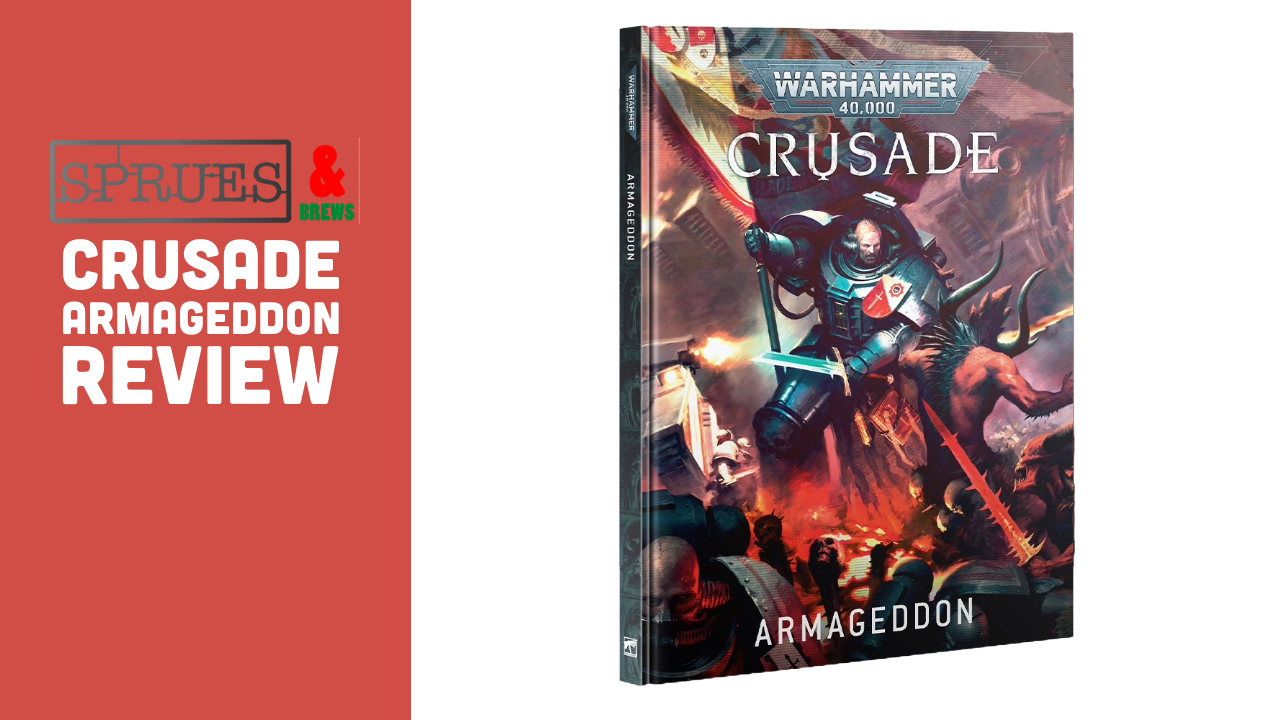
Armageddon, a world whose name is known across the Imperium. Armageddon, a world whose name has become a byword for war and destruction on a massive scale, Armageddon, where the fate of a thousand worlds hands in the balance.
During the end of the Great Crusade the world of Ullanor Prime was liberated by the combined might of the Luna Wolves, the White Scars and the Ultramarines under the command of the primarch Horus Lupercal (who would be named Warmaster once the Ork world was finally defeated).
Since that moment of triumph for the forces of the Imperium of Man, Armageddon has been engulfed in numerous wars. From the Daemon Primarch Angron and his cultists overthrowing the planet, to two invasions of the planet by the Ork Warboss Ghazghkull Mag Ulrk Thraka there has been only war.
Now, 10,000 years after the planet was first claimed a new war has broken out, and in Crusade Armageddon we learn of the events of this new conflict, and also are given a tool box in which to play through this conflict through a Warhammer 40k Crusade campaign.
In this review we’ll be taking a look at the new supplement, seeing what it adds to your Crusade games, and deciding if this is worth adding to your collection.
Massive thanks to Games Workshop for sending us over an early review copy – If you would like to support the site then why not order your copy through our affiliate Element Games and save yourself money too?
If you are into Crusade then we have also previously covered the Pariah Nexus book too!
So without further ado let’s head back to Armageddon to see what is kicking off!
The Lore
Now, talking about the lore in these reviews is always tricky to balance – I want to tell everyone all about it and all the twists and turns, but equally it’s something that people deserve to be able to experience themselves. So I’ll go through the high level beats of the narrative without going too deeply into any spoilers, so that if you want to experience the story for yourself you can!
First up, there is a lot of new lore here! The first 67 pages of this 129 page book are all new lore that explores this 4th war for the planet. While big lore altering storylines normally wait for the end of an edition, Crusade books have been great at shining the light on a particular conflict and allowing the writers to go to town developing it and telling an interesting story with multiple different factions involved.
In this book we get the history of Armageddon and it’s background, but that is only really saved for a couple of pages, with the rest of the space dedicated to this new story. Sometimes too much time is spent retreading old ground, but that’s not the case here thankfully with the greatest chunk of the book telling us of the 4th war for Armageddon.

Without giving too much away here, the plot is about Angron and the World Eaters returning to Armageddon to finish what they started all those years ago, but they are not alone with the Space Wolves, Black Templars and Grey Knights joining the fray in order to try and stop him. There’s a couple of interesting things that may be the seeds of the continuing storyline into 11th Edition too. For example, the Space Wolves are on the verge of fully eliminating the Ork threat in the system, but the call to aid draws them to Armageddon before they are able to finish their task. Could the Orks be multiplying and rising as a new threat due to the fact the Space Wolves have not been able to fully eliminate them?
Visually this book is great too, with new artwork, detailed lists of forces for the armies involved and maps of the conflict zones. While maybe not reaching the gritty crunch of the old Imperial Armour campaign books, I do think the book does a great job at bringing the conflict to life both for the excitement of the narrative and as a tool box for setting your own campaigns in. This also fuels the imagination of competitive players who want to add some narrative flavour to their events, and perhaps even dip their toe into the narrative side of things.
There’s focus on a lot of factions that have recently been released, such as the Space Wolves, World Eaters and Death Korps, but with the Grey Knights and Black Templars also getting a lot of screen time it wouldnt surprise me if those factions get Codexes soon after this book too.
Armageddon Crusade Rules
So what about the gaming content? Well, the rest of the book is dedicated to Crusade and acts as a one stop shop for all your Crusade needs. Rather than having to flip between multiple books, the core Crusade Rules are included here explaining all the steps you go through to create your Order of Battle, making your Crusade Cards for units, managing and using the various resources that you obtain during campaigns along with all the post game actions such as Out of Action tests, Battle Scars, Battle Honors and Experience.
Having played through numerous Crusade events either at home or at Warhammer World, it was always a pain to lug around the core rulebook in order to have the various charts you need to roll on after battle, so including all these rules within this supplement is a massive win in my books and reduces the amount of things you need to carry with you to games.
The Armageddon Campaign
As you can imagine, the remainder of the book is dedicated to the Armageddon Campaign itself. This is essentially a “mission pack” that allows you to create your very own Crusade Campaigns within the setting of the 4th War for Armageddon.
What’s really nice about this campaign is that you can run it with anything from 2 players to 20+ with players being arranged into 3 teams – The Gatebreakers (who represent the forces who are trying to stop Chaos – recommended to be Imperium, but not required), The Desecrators who support Angron’s plan for Armageddon (Chaos, but again could include anyone) and the Marauders which represents all the other forces looking to take advantage of the situation to their own goals.
The campaign is broken down into 4 different phases and in each phase each player will have a number of battles in order to try and gain “strategic points”, with the team with the most strategic points winning that phase. What’s really nice here is that the campaign speed is scale-able. The “Normal” length campaign is set at 3 games per player per phase – so if you are able to get in a game of Warhammer every week then each phase would take 3 weeks, with perhaps a week off between phases for book-keeping, and a full campaign taking 4 months. On the other hand you could opt for a “Very Fast” campaign where each player only has a single game per phase meaning you could complete the entire campaign in a month! This is great as people often don’t have months and months to dedicate to a campaign, and the ability to have fun playing through this storyline without needing to have that massive time commitment is brilliant, especially for older gamers who have a lot of free time taken up with boring things like adult life.
What’s really nice about the campaign is that there is a branching tree for each of the three teams – depending on if you win or lose that phase it unlocks a different “quest” for the following phase. So for example, with the Gatebreakers phase 1 just has you trying to win games – if your team wins then in the next phase you are able to increase your supply limit in 250 point increments rather than 200 point ones to represent your early success on the battlefield, and you’re given a new mission to try to end the game with 2 or more units in your enemy deployment phase, do that and in the following campaign you’re able to set up units in reserve early. On the other hand and lose the first phase and you instead gain the ability to reroll battleshock to represent the forces being hardened by their defeats and are challenged with trying to keep enemy units out of your deployment zone, with the reward of extra XP in the next phase if successful.
With all three teams having different objectives and different rewards it leads to a more different push and pull of the battles, and also opens the door for players to have a different experience if they play through the campaign again, which is a nice touch!
Like with all Crusade supplements, players also get access to a load of new Battle Traits that cover all unit types. These expand on the ones in the core rulebook with more thematic ones suited to Armageddon. There’s some really fun stuff here such as the ability to give units Invulnerable saves, allow monsters to crash through buildings, or have beasts radiate an aura of terror that reduces the leadership of nearby units.
Another cool new addition are Mighty Champions – these are essentially upgrades you give to named characters that give them a cool new rule. As Epic Heros don’t “level up” during a Crusade, this is a nice way of giving them an additional fun rule that isn’t normally seen in matched play. There’s 7 different rules, and it’s up to the Campaign Master to select the most fitting one for each character. What’s really cool here is that the book also lists the “Historical” ones that would be on various characters – so if you take Angron then he gets “Nemesis Champion” which means if he kills a character then every model in your army gets 1 bonus XP at the end of the game, or Helbrecht gets “Front Line Champion” which gives them “Anti Unbound Adversaries 4+” – We’ll talk more about Unbound Adversaries later, but essentially they are non player controlled Daemons that can attack either side during missions.

A full suite of thematic Relics are also included which options that would be fitting for any of the three factions. Some fun ones include a totem that causes mortal wounds to nearby units when the bearer is destroyed, and then summons a unit of daemonic unbound adversaries into existence to get vengeance on whoever killed the bearer!
In keeping with the warp ravaged environment of Armageddon, the book includes some special Hellscape rules that give some flavour for your games. Each mission contains one of 8 different hellscapes (with a chart also provided to use these in other games) that represent some of the events that happen due to warp exposure. For example Folded Space allows you to do an action on an objective in your deployment zone in order to teleport to your opponents deployment zone! Dabbling with the warp has a price however, and a lot of these abilities give “Warp Tokens” which interact with other rules in the campaign pack. Another cool example is Banishing Rifts which allows you to draw a line between two objectives you control, dealing D3 mortal wounds on anything it crosses before dumping those units into strategic reserves. While some of these may be a little wacky for Matched Play, they certainly capture the imagination for Narrative Play.
In addition to this, the book also has rules for Anomalies – these are random events that are created by warp events – players roll on the scale and intensity of the warp rifts wracking the planet, and based on the results rolled then a number of different events happen in your games. Some of these may just give units warp counters, but others may do damage to your units or instead grant units with warp counters special rules like lethal hits or even lose the ability to shoot – this makes having warp counters a real gamble, as you are just as likely to roll something that adversely affects them as you are a bonus.
Unbound Adversaries is a very cool rule that allows for game controlled daemons to pop up during the battle. These are controlled using a logic similar to that seen for NPOs in Kill Team – so for example in the movement phase they will move as close as possible to the nearest unit, then they will shoot and charge if possible. This means that in many of the scenarios you are not only fighting your opponent, but also waves of Daemons. A clever player can use this to try and take advantage of the situation. These Daemons activate at the very start of each Battle Round, so can quickly become a real problem if left unchecked!
Rather than use use existing profiles, the book actually contains a number of generic Daemon profiles to use to represent these – Greater Deamons (Represented by Bloodthirsters etc), Lesser Daemons (Bloodletters etc), Abomination (a larger Daemon around the size of a Chaos Spawn) and Daemonic Beasts (Something the size of a Juggernaut) – while the narrative is focused around the Khorne forces assaulting Armageddon, you could absolutely use other models and get a bit creative here!
As ever with Crusade books we also get a unique list of blessings and agendas to pick from for your games – but what is new are “tactical agendas” – these allow you to generate a random agenda from 3 different tables (18 options in total) – this is fun and allows you to leave things to fate and just roll up a random one on the fly, something I’ll absolutely be giving a go!
Finally, the book contains 16 brand new Crusade missions. What’s really nice about these is that 8 of them are standard symmetrical missions, but in a move that mirrors some of the changes seen in the new Chapter Approved card pack the other 8 of them are asymmetrical with differing deployment zones and victory conditions per player. This has been a great addition in Chapter Approved, and I loved seeing it here too – 18 missions also stops things from getting stale, especially if you are looking to run a longer length campaign.
Summary
I’ve been a massive fan of Crusade since it was introduced to Warhammer 40,000 and Crusade Armageddon is another excellent source book that already has my mind running with ideas for campaigns and narrative events. While i’ll certainly be using all of the contents of the book, there’s nothing to stop you using just elements of it if you want to – a lot of the additional rules add a little “chaos” to proceedings, but I feel that this is something you should embrace in this kind of rules pack. If you’re looking to use this as the foundation for something more “competitive” then you might want to tone down some elements to stop winners of early games from running away with it. I do think that things like Unbound Adversaries helps by throwing a spanner in the works though, while still doing it in a thematic way.
I really hope that Crusade continues to get some love for the rest of the run of 10th Edition, and I pray to the Dark Gods that we see more books like this in the future.
Crusade Armageddon is up for pre order today and is released on Saturday 7th June.
Games Workshop provided Sprues & Brews with a free copy for review purposes.

Leave a Reply