
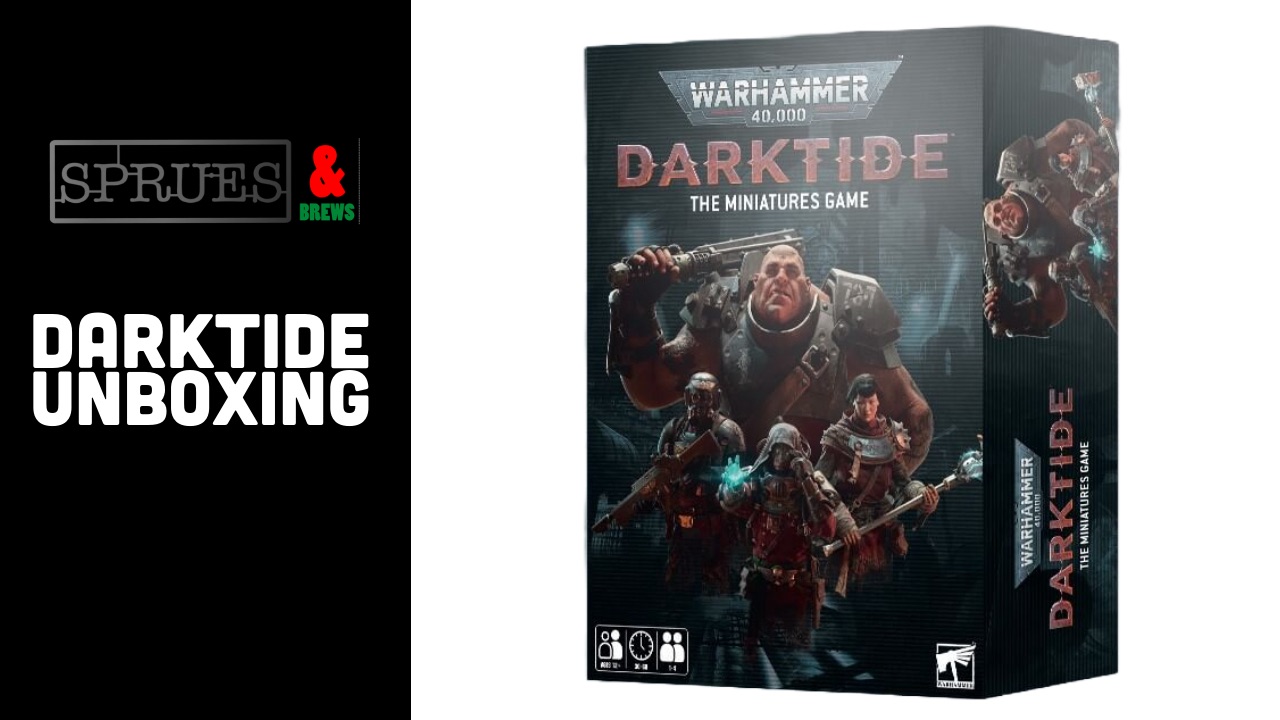
A miniatures game, inspired by a video game, which was inspired by a miniatures game.
Welcome to Darktide.
What is Darktide?
Darktide is, in the simplest of terms, a follow up videogame to the very successful Vermintide game. Both were made by the studio Fatshark.
Whereas Vermintide was based in what we now call The Old World (The World-That-Was, Warhammer Fantasy, delete as appropriate) Darktide instead traded sword and sorcery for the guns and aliens of Warhammer 40,000.
Both video games followed the same basic concept. 4 characters, getting from point A to B, whilst battling a whole bunch of enemies. A Co-Op experience in the same vein as Left 4 Dead.
What is Darktide: The Miniatures Game?
In short, the boxed skirmish game is based off the videogame, and has been dubbed by Games Workshop themselves as a Kill Team-Lite game that they hope will get newcomers to playing Warhammer to leap from this to Kill Team proper.
It is a 2-4 player cooperative game, where players control the 4 Operatives whilst ‘the game’ controls the enemies using a Behaviour mechanic.
Our thanks to Games Workshop for sending us a copy of Darktide to review! You can preorder a copy right now. Why not use one of our Element Games links and save some money Vs RRP AND help us out too!

You have 4 Operatives (player controlled characters) facing off against Poxwalkers and Traitor Guardsmen, who are basically controlled by the game mechanics. The missions (of which there is six in the rule book, which in turn are broken down to 3 Rounds per mission) are played out on small Kill Team boards covered in hexes.
In short you’ll be grabbing objectives whilst fending off Traitor Guardsmen and Poxwalkers.
I’m not going to mention the cost of the box until the end of the article, purely to help you value this box from the review. You’ll understand by the end of the review!
What’s in the Box?
You can see for yourself in the below unboxing video!
Below is a full list of its contents:
- Campaign/Rulebook
- 10 x Dice
- 10 x Operative Datacards
- 17 x Equipment Cards
- 24 x Upgrade Cards
- 21 x Activation Cards
- 4 x Kill Zone Tiles (Double Sided)
- 2 x Token Sheets
- 6 x Poxwalkers
- 10 x Traitor Guardsmen
- 1 x Psyker
- 1 x Veteran
- 1 x Ogryn
- 1 x Zealot
First Impressions
I’m going to be honest, when I first got my hands on the box I have to admit my expectation bar was fairly low. It looked light on content, with small boards, and zero new minis. Although it did look better than the Space Marine 2 tie-in game that recently hit the shelves.
The outer box is not up to the usual GW standards. You’ll struggle to keep it looking it’s best. I know it’s only a box, but at this point I’m used to the quality of boxes that GW puts out.
I’m not sure if it is me, but the quality of the sprues seems to be a little less detailed than when I’ve seen these minis previously. I could be wrong, maybe its the colour of the plastic throwing me off. I do however like that the Operatives come on Blue sprues, whilst the enemies are on Green sprues, as it follows the same idea as Underworlds. Should you choose not to paint your minis, then at least it is easily distinguishable from the colour of the models who are the ‘good’ guys and who are the ‘bad’ guys.
The tokens, rulebook and boards are all top quality. No cheap tokens here. The gaming components are all up there quality-wise with Kill Team and Underworlds, so no complaints here.

The box includes 4 small tiles, and most missions use 2-3 of them, so if you only have a small coffee table to play on then this game is ideal. The whole box is aimed at just that, people without masses of space, looking for some quick-fire dice-rolling fun.
The Rules & Rulebook
The rules lean in to Kill Team, as you would expect, but perhaps not as much as I expected.
Shooting is similar in that you only have a To Hit characteristic. Your datacard tells you the range and number of shots your weapons have. Instead of a measurement gauge, the game uses the hexes for the purposes of range weapons and of course movement. Everything in the game has a movement value of 3 hexes.
Going back to the shooting mechanics, once you have shot, you roll for the enemy you’ve taken aim at. You get to roll 3 dice, and you are looking for 5s to ‘save’. Should any of the enemy shoot your Operatives, then you also get to roll 3 dice, only you are looking for 4s instead.

Combat works again, in a similar vein to Kill Team. You roll the number of attack dice for both your Operative and the enemy you are in combat with. You then get to choose to either ‘pair up’ the successful dice rolls to negate damage, or you can use successful damage to hurt the opponent model (potentially leaving them to do damage to the Operative).
Your Operatives get to make 2 actions per activation, these being movement, shooting, combat and actions. The Poxwalkers and Traitor Guardsmen are controlled by the Behavior charts on there datacards, which is super straight forward to follow. Speaking of the activations, these are made at random by creating a deck at the start of the game. You then shuffle them and pull out a card from the top of the deck. This will either be an enemy card, with an image of the exact mini you need to move, or a general Operative card, in which you can choose which Operative to move next.

The rulebook is fairly clear and concise when it comes to the rules, however as I’ll discuss in a moment, it doesn’t quite hit the mark in some regards. It does however have some stunning artwork from the Darktide videogame dotted about its pages, and there is plenty of background of the setting in which Darktide takes place to enjoy.
Between missions you can upgrade your characters with different equipment cards. You get a deck of equipment cards per Operative, as well as a general small deck of generic equipment that can be added to any of your Operatives, helping you out in some of the later, more difficult missions.
Missions
Their are 3 Missions in the Rulebook, however these are broken further down in to 3 rounds. They’ve done well to make them feel like missions from the videogame, and make the most of the 4 small tiles that come with the box. Some missions include the use of a Servo-Skull token, for example the Escort mission, which is fun and another great inclusion to add more variety to your missions.
Playing a Game | Teaming up with the Wife!
The best way to get a feel for a game is to of course…play a game! With Darktide being aimed for new players, it would be even better to play alongside someone who hasn’t really played Warhammer before.
So I managed to get Leanne, my wife, to play along with me!

Now, this isn’t the first time she’s played Warhammer, as I managed to get her to play a mini game of Age of Sigmar during lockdown.
The game is designed to be played by 2-4 people, although you could play it solo too. This line is pretty important, which I will come to shortly.
So anyway, myself and Leanne set up Mission One, Round One, on our living room coffee table. The first mission only uses two boards, and their was plenty of space on the coffee table for the boards, datacards and other bits and bobs.
Leanne choose the Psyker, whilst I went with the Veteran Guardsmen. The first mission uses all 6 of the included Poxwalkers. The setup clearly shows how the mission needs to be setup, from the characters, to terrain tokens (and although their aren’t any in this mission, objective tokens).
It did however very quickly become apparent that between our two characters we weren’t doing enough damage to these Poxwalkers, and then I realised…their must be some form of difficulty adjustment between the numbers of players taking part…so I went back to the rulebook…and realised our first error. You always need to play with all 4 of the Operatives, so what we needed to do was to play 2 characters each. I wanted to raise this as a point, as I missed it within a single paragraph of the rules.
The next evening we went for another game (this time using the right amount of characters!) and the experience was much more balanced. From playing Kill Team though…it didn’t…feel like I was playing Kill Team. It felt more like some form of Warhammer Quest: Blackstone Fortress crossed with Warhammer Underworlds, with Kill Team tokens and cards.
The few missions we played were fairly quick, especially once Leanne got in to the flow of the combat and shooting mechanics. They didn’t feel too short, so you should be able to get through the campaign in a couple of gaming evenings.

Leanne enjoyed the game, but admitted she’d prefer to concentrate on a single character rather than switching between the two. It is easier to balance the difficulty of the game by always having to use all 4 Operatives, rather than having some form of difficulty adjustment mechanic depending on how many Operatives you are playing with. I asked her if she’d ever want to go on and play Kill Team and sadly…the answer was no.
Summary
The outer box to one side, Darktide contains a high quality level of models and tokens, which is ideal for quick-fire games with a small gaming footprint, with some added depth thanks to the array of missions and equipment cards.
It’s billed as a Kill Team-lite game, but I don’t think it includes enough Kill Team mechanics. The hex movement system and enemy Behavior mechanics makes playing the game feel like you are playing Warhammer Underworlds with a hint of Warhammer Quest.
The big question is, if you were to host a gaming evening, would you set time aside to play Darktide…and in all honesty, I probably wouldn’t. The missions are varied and the equipment upgrades are cool, but the game feels like it’s missing…something. It just doesn’t have a unique feature that ‘makes’ you want to play it. Their are a lot of co-op boxed board games out there, and aside from the tie-in to the videogame, Darktide really doesn’t bring anything super new to the table.
I guess however, that the aim of this release wasn’t really for experienced gamers, but to draw gamers in to play Warhammer, specifically Kill Team, but again I just feel like it misses the mark. Especially due to it’s price point, which is really important.
The RRP of Darktide is £65, and that is just, IMO, too high. If you want to encourage new players to get in to your game you need to have a boxed game which, at the most should be priced at £50. I mean, let’s compare this box to the Kill Team Starter Set, which is also £65, but includes terrain, larger boards, more models (2 complete Kill Teams), tokens and a full Kill Team rulebook. If I was going to spend £65 and had any thoughts about starting out in Kill Team…I know which box I would lean towards.
I cannot help but feel that Darktide would have worked so so much better as a full, Warhammer Quest, style game, where it could have really leaned in to the Co-Operative element of the gameplay, with larger, more interesting boards. Darktide certainly has the artwork and narrative to drive a larger box game.
I had fun playing Darktide, and it’s the first time I’ve managed to get Leanne to sit down and play a boxed Warhammer game with me, however it misses the target in it’s overall goal and is simply too expensive for what it is.
If you want, or have any incline to play Warhammer 40,000 Kill Team, then pick up the Kill Team Starter Box. If you want a board game you can play with 3 other friends with a small footprint, that doesn’t really bring anything new to the board game genre, and the £65 doesn’t put you off, then this game could be for you.
There are a lot of positives in this box, as it is fun and well thought out, but the price doesn’t justify it sadly.
Our thanks again to Games Workshop for sending us a copy to unbox and review.

Leave a Reply