
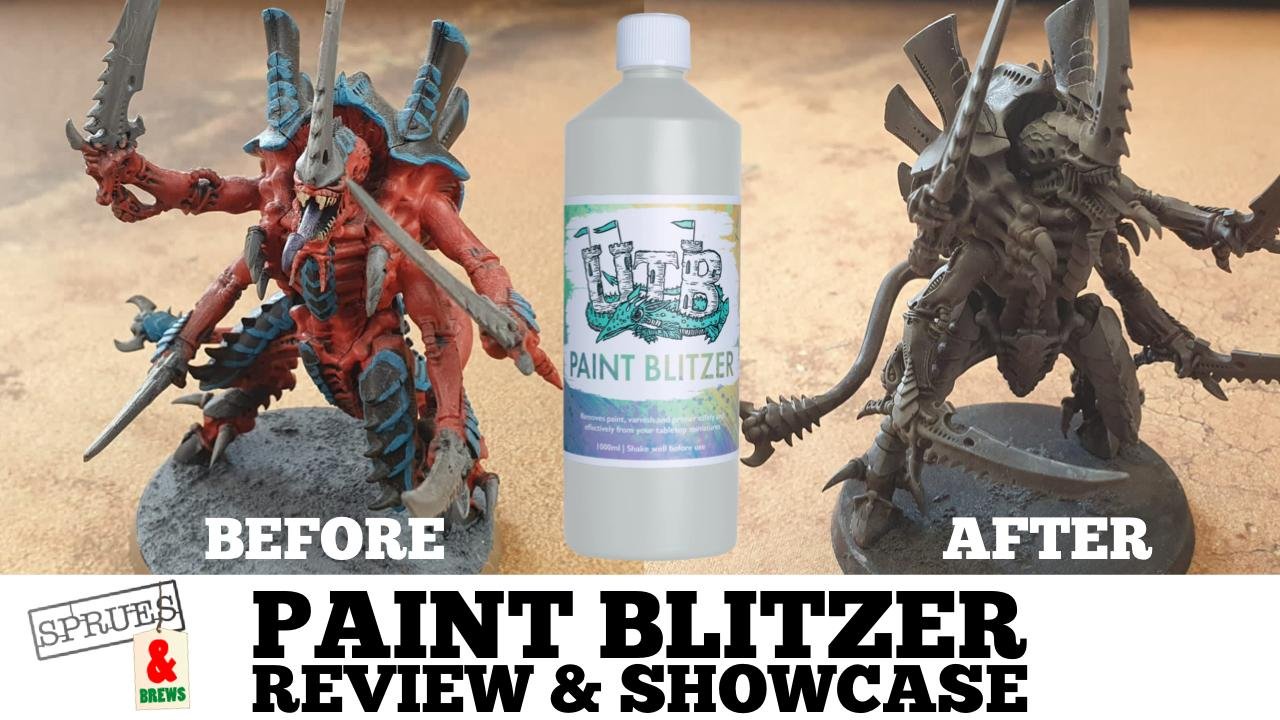
We’ve all got those models haven’t we? The ones that we painted years ago that don’t quite stand up to your current skills, or those experimental test schemes that didn’t quite go as planned, or even that eBay lot you got for a bargain but are caked in years of paint!
In the past I’ve tried a few different ways of getting paint off models, and I’d always tended to resort to classic brown Dettol for my paint shifting duties. But there’s always been a few flaws with that – First, it’s not really designed for stripping paint, it’s just a fortunate side effect of the chemical make up of it. Next it takes a while – I’d get a plastic tub, stick some models in it and give them a good old bath for a night or two to loosed them up. And even when you left them for ages, after all the scrubbing there always tends to be paint left on the model – and don’t even try using water to speed up cleaning them off, as that will just turn into a horrible gloopy mess!
And finally, it stinks. Use Dettol to strip minis and your house will have that distinctive tang for days!
So when Unto the Breach Hobbies sent us a free review bottle of Paint Stipper to try out I was very intrigued into just how good it was. I’d heard some good press about it elsewhere on social media, and by all accounts it did a decent job, the question though is how does it do in practice!
In this post we’ll be checking out Paint Stipper and seeing how it does on Resin, Plastic and Metal models and trying to answer the question of “What is the best way of stripping Warhammer models?”
I’ve also recorded a full companion video to this which you can check out just below or over on our YouTube
If you would like to help support the site then why not order your hobby supplies through our affiliate Element Games and save yourself some money too?
So on with the testing!

So before we got started we needed some test subjects. I wanted to have a resin, metal and plastic model so that we could see how the solution worked on each of them, as some products tend to be more effective on certain materials. I dug into the collection and pulled out an old Bilbo Baggins I painted around 20 years ago, A Swarm Lord I had bought from Dave and wanted to repaint in Leviathan colours to fight alongside my nids from the new 10th edition launch box, and the old resin Ripper Swarm from Forge World. This gave me a nice range of materials to try out the solution on!


I also had a few “benchmark” models that had previously been stripped with Dettol to act as a comparison to paint blitzer. The Hormagaunt had taken a few bathes in Dettol but still had paint here and there, and the Gargoyle was caked in a bone coloured paint and yellow staining that I’d not been able to get out any other way.

So how does it work? Well ideally you’d want to fill a tub and put multiple models into it in order to maximise the Paint Blitzer – however, I was doing different materials and it was important that these came out of the mix at specific times.
Unto The Breach recommend that models are left in for the following time periods:
Plastic: 30 mins – 2 hours
Metal: 30 mins – 3 hours
Resin: no more than 30 mins
If anyone has had a resin model melt on them while trying to strip it you’ll know the importance of that last one!
So I set my timers, waiting for the Paint Blitzer to work it’s magic…

Looking into the tubs after 10 mins or so, I could see that the solution was already doing it’s stuff, stripping the paint from the model as the once white mix turned into something of a Tyranid Biomass feeding pool…

As the tubs started to turn into a Jason Pollock painting, the time had come to start to remove the models – starting with the resin one about 20 mins into proceedings.
The Paint Blitzer is really really to use – head to a sink and you take a toothbrush (hopefully one you are not using on your teeth!) and give the model a good scrub to agitate the solution. this turns the mix into a bit of a pasty gloop and you’ll notice that the paint will be lifting off with the liquid.
You then simply scrub the model underneath running water and the paint and Paint Blitzer will simply run off the model – no lucky mess like with Dettol, though do make sure you do this over the sink and be careful of splatter from the toothbrush in order to not cover your surfaces with paint residue.
Paint Blitzer is safe to use without gloves, though if you have sensative hands I’d recommend wearing gloves – after an entire day of stripping models for the review my hands had started to get a little dry (Though it was a LOT of stripping I was doing!)


On the Ripper there was still a little paint in the recesses, but most had come off from the surfaces – To be fair, I could have probably have left this for another 5-10 mins and probably would have had better results. But for a resin model with no damage to details I was very happy! I simply gave the model a good rinse and left it to try while waiting for the other models to emerge from their relaxing bath.

So 2 hours after putting the Swarmlord into the mix he was the next model to be removed, and I’ve got to say that the Paint Blitzer did a great job!


On plastic this stuff is phenomenal, with the miniature looking like brand new! What I also noticed on this one was that the Paint Blitzer also stripped the majority of the Citadel Basing Paint on the base of the model – I guess as this is paint based with microbeads rather than sand the stripper has an easier job of doing it


For metals the Paint Blitzer also did an amazing job getting the model looking good as new again!


For the control models, the Hormagaunt came out of the mix with all that stubborn paint removed, but the Gargoyle failed a little worse, the yellowing had gone but there was still some hard yellow paint in places, but I suspect this is actually adhesive that has been used to hold the model togther
So yeah, pretty sucessful test! But then I thought “Can you reuse it?” and so I popped some more test victims into the not so white mix that was left over from this batch


And again, once soaked for a couple of hours they came out with the paint removed! Now I will say that Unto The Breach told me that while it can be reused, it is less potent – and you can see this here where the models do have some staining – though this quickly vanishes once primed again!


And then I was on a roll, stripping an assortment of models both big and small – Something like the Tyranofex here is a little tricker to do in a tub – so what I did was poor the Paint Blitzer over it, and then massage the solution across the entire model using a paint brush. I did have to do a couple of passes as this is a big model – but as you can see above it cleaned up fine! Using the entire bottle you can see in the final picture above how much I got through, and that was being generous making sure i was giving it a fair review – in reality you could do a lot with a single batch!
So is Paint Blitzer the best way to strip Warhammer models?
That’s a tough question as it’s a personal preference, but having used Paint Blitzer I’ll not be going back to Detoll, for me Paint Blitzer absolutely does what it says it does and gets models good as new in not much time! Once I finished filming this review, I actually went online and ordered myself a 1 liter bottle of Paint Blitzer and I’ll be ordering more once done. Stripping models has always been a bit of a chore, but Unto The Breach have done an amazing job here at making this much easier and much less tedious. I highly recommend trying this out if you have old models to strip – I myself have got some The Old World projects that i want to get fighting fit for the launch of the game, and this is a great excuse to get them stripped and painted up again!
Paint Blitzer is available from Unto the Breach Hobbies for £13.49 for a 500ml bottle (This is what was used in the review and was provided by Unto the Breach for free) or £23.49 for a large 1l bottle


Leave a Reply