
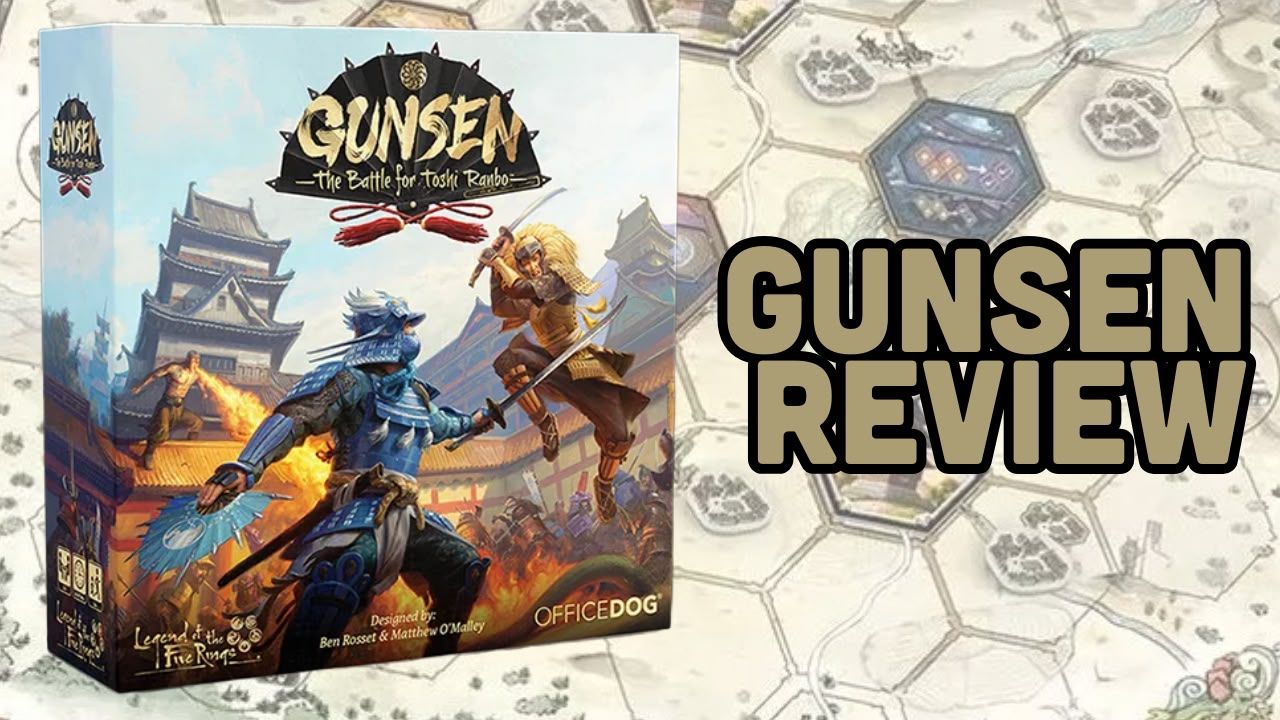
Based on the Legend of the Five Rings setting, players compete as the Daimyo of one of the seven great clans and lead their military to victory in Gunsen The Battle For Toshi Ranbo by Office Dog Games.
In this full review we’ll be taking a look at the game, seeing how it plays and talking about how it plays across different player numbers. Massive thanks to Asmodee for sending us over a copy to check out on the site. If you would like to support the site then why not pick up your games through our affiliate Element Games and save yourself some money too?
So without further ado let’s check out Gunsen The Battle for Toshi Ranbo!
Gunsen The Battle for Toshi Ranbo Review

The Legend of the Five Rings is a property that hasn’t nearly had enough attention recently. For those who don’t know, this setting started life as a collectable card game set in the feudal Japan inspired empire of Rokugan. In this land, various different factions battle both within and without for the title of Emperor. As you can imagine, this makes for a pretty good setting for a board game too!
In Gunsen, each player takes control of one of 7 different clans – and though the balance of influence, resources and military might fight for the control of the strategic fortress of Toshi Ranbo. But simply having troops in the fortress is not enough to win, with each of the clans also trying to achieve a number of different objectives in order to claim victory.
From a gameplay point of view, each player is looking to achieve 7 out of 11 possible achievements. And there’s actually a range of different goals here that suit different play styles. You can score (up to twice) for winning battles, but you also score points for constructing buildings, holding multiple shrines or taking control of Toshi Ranbo itself. What’s really nice here is that its really quick and easy to score these, and with a range of objectives up for grabs you need to not only keep track of what you’re scoring, but also where you opponents are up to – as a player can quickly run away with a couple of achievements if they have a good turn. This leads to games being really quick and punchy, with a game easily possible within an hour!
Each of the 7 factions (clans named after various animals such as the Crab, Dragon or Unicorn) also has their own Clan-Specific goals, buildings and mighty heroes, which goes a long way to make each of them feel different and reward finding a clan that suits your own play style. You’ll also learn what other clans want to do and how best to try and stop them from completing their achievements too.
The game is 2-6 players, but in a really nice touch that ensures that even low player games are still making resources and space limited, the board is actually double sided, with one standard sized board for 4-6 players and the reverse being a smaller environment for 2-3 players.

The game looks really nice when set up, though even for 2 players you are going to need quite a bit of space due to the number of cards, components and dash boards, but even a 4 player game should squeeze onto a standard dining room table (higher player counts are going to need some more room though).
All the components are dripping with flavour. From the player dash boards (covered in unique art for each clan), decent plastic tokens for your armies and objective markers and decent quality card tokens for resources and locations. Even the board itself and the cards are gorgeous and really sell that alternate ancient Asia vibe that the setting has.
One thing that I do want to call out about the game is just how good the storage solution is. Not only do you get enough baggies to put all the tokens away in, the box also has a dedicated close-able section to pop them all into when in storage and 8 individual boxes that hold all of the cards, miniatures and bits for each of the 7 clans, plus an eighth one that holds all the neutral ones too. This is a great touch and makes setting up and breaking down Gunsen really painless. Only playing with 3 players? Great, you just need to pull those 3 boxes out of the box plus the neutral box – no sifting through a bag of tokens to make sure you have everything you need. Likewise cards are split by player count (2-3 and 4-6) and are easily stored separate in the box so you can just grab the deck you need for the game you are playing.

So how does the game play? Well it’s got a really simple but slick mechanic that revolves around different tracks on the player dashboard. Essentially, there are 4 tracks that each player has.
Armory – Determines your effectiveness in combat
Recruit – Represents the numbers of troops you are able to recruit
Influence – Represents your political influence and your ability to spend this
Expand – Represents your physical resources such as coin and wood, plus your ability to use this to build structures and spend your coin on special abilities.
Each turn a number of cards are drawn out that fit into one of these four different tracks, and players will have the opportunity to pick one of these cards and add it to one of the tracks. This is done by slotting the card behind the track, and each card placed this way extends what can be done in that track. For example the Recruit track starts with placing a new troop, moving an army a space, and the ability to buy extra movement with influence. But you might have a turn in which you really need a lot of troops, and so you decide to play a card that allows you to place another 2 troops. These additional cards you have slotted will come into play every time you activate that track, making specialising in a couple of tracks very powerful (or having a less specilaised spread across all tracks making you more of a jack of all trades and more able to react to whatever is drawn that turn.)
Gunsen has some balancing mechanics here in that the more powerful cards have a cost that has to be played in order to take them, and those resources may be gained by a different track – making turns an interesting back and forth in making sure you have both the resources and cards that you need, while also trying to deny your opponent of the cards that they are going to need.
You’re going to want to start out with a particular objective in mind to get going, as in early turns you’re going to have limited resources to do everything. I found it was easier to try and lean into some of the faction specific objectives first, as the clan cards and buildings normally lean into these play styles.
By midgame in Gunsen you’re dancing around the board with your armies, building and defending important structures and trying to get yourself into positions that can score you points such as taking the shrines or fortifying Toshi Ranbo (which is essentially worth 2 points, one that is gained when you first take it, and a second for having control of it – though this is lost as soon as someone takes it from you)

Another thing that Gunsen does really well is combat. There’s a combination of a random element in a dice roll, combined with increasing stats through the Armory track. Essentially, each player has three different tracks – Strength (a representation of how likely you are to win a battle), Blood (how many troops you kill during a battle) and Armour (how many troops you can protect from being killed during a battle).
As the game progresses, you’ll add cards to your Armory track that give you different values in these three stats. When you have a battle you start by putting the results of each of these stats for each player on the battle tracker using tokens. Then each player (starting with the defender) rolls a number of dice – this will start out the same for each player, but certain cards and upgrades will alter the number that each player gets. The dice have extra Strength, Blood and Armour symbols on them, and the strategy here is using your limited rerolls in order to try and get the symbols you want, then you get to retain a number of dice in order to add to your battle tracker. Again, at the start of the game you’ll only be allowed to keep 2 dice, but this again can be increased with cards and abilities. Once the defender is happy and has updated the tracker, the Attacker gets to do the same. Once the dust has settled, every blood point will kill a model, with every armour point stopping a model from being killed, finally the side with the most Strength symbols wins the fight. This results in some really interesting situations where you might win an important fight, but actually lose all your troops. And there’s some fun objectives that have you try and do exactly that!
As a bit of insurance in tough battles, you are able to hire heroes that can accompany your troops to battle. These tend to have fixed Strength, Blood and Armour values on them in order to help to your side win, but often they also have some special abilities too that trigger in different circumstances. Again, if you want to hire these heroes you’re going to need some resources or use your turn instead to trigger a Noble Action (These cost influence and a card being sacrificed, but these have very good benefits and triggering 3 gives you an achievement)
After a couple of rounds combat was quick and intuitive, and it quickly became apparent how important the previously overlooked Armory track was!
Summary
So what did I think of Gunsen The Battle for Toshi Ranbo? Well, from the moment I opened the box I was in love with the aesthetic. I’m a sucker for all things Oriental, and there has been a lot of love poured into making the components carry this theme, from cards that look like they could be woodprints, to artwork that is absolutely gorgeous, even on tokens and tiles.
In games like this I often worry that the game won’t be as fun with lower player counts, but by having two different board sizes they eliminate this problem by instead just getting rid of the extra space in a small game to force people into conflict early on. With some abilities that allow quick movement around the board you have to make sure you shore up some defenses and not blow all your cash on trying to unlock your soft objectives early on.
Combat was also great fun too – It’s a nice mixture of having a random element in the dice roll, but with resources poured into Armory you can give yourself a little insurance and give yourself a little more reliability in your troops.
Gunsen plays really quickly too, and that might be a downside for some people, as just when everyone has found their footing and is starting to put their plans into motion it’s possible for a player to grab a couple of critical objectives in a single turn and get an unexpected victory. This is probably something that will become less of a problem with repeated play, as you’ll start to learn not only what you want to do, but also how to hinder your other players too.
Gunsen is a brilliant game, and I’m already excited to play some more – and with a price tag of £59.99 this one is decent value too! If you’re a fan of fast paced games and have an interest in Fuedal Japan (even if you have never come across the Legend of the Five Rings before) then you’re going to like this one!
Gunsen The Battle for Toshi Ranbo is out now!
Asmodee provided Sprues & Brews with a free copy for review purposes.

Leave a Reply