
We’re on a Path…to Glory!
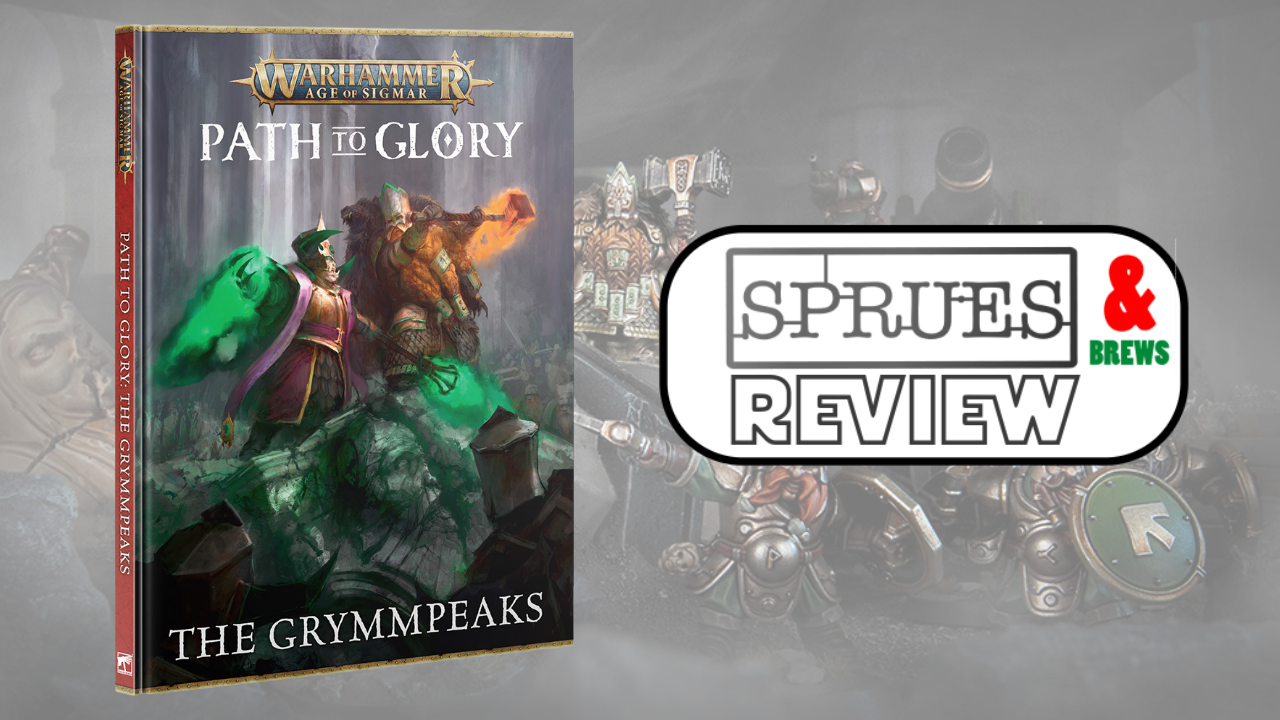
Welcome back to another book review from Sprues and Brews, and for this article we are taking a look at the brand new Warhammer Age of Sigmar Path to Glory supplement, The Grymmpeaks!

The Duardin (cough, Dwarfs, cough) of both flavours (Order and Chaos) are the main feature here in a Path to Glory book that focuses on battles taking part in the chambers of a Duardin Fortress. I’m a big fan of the Path to Glory content so far for Warhammer Age of Sigmar, so my hopes are high for this one.
Our thanks to Games Workshop for sending us a copy of the book to review for you folks. This book is available to preorder right now, and should you wish to purchase it from our affiliates over at Element Games you’ll save some cash VS RRP and help us out too!
Let’s delve in!
The Grymmpeaks | Book Contents
When you pick up this book, you do also get a punch board which includes various tokens, such as mine entrances, mining carts and Hazard Makers. You also get some walls as well, to help represent the games you’ll be playing in a Duardin Fortress.
Like the fact they’ve included these, and makes me excited for the upcoming Battleplans, that we’ll be checking out a little later in the review.
Lore of the Grymmpeaks
The lore in this book is absolutely fantastic. The main factions represented here are the new Khazalite Hold dwarfs and the Helsmith of Hashut dwarfs.
Ogors, along with Giants and the spooky Nighthaunt round out the forces featured within the stories and background of this book, which is a really nice mix of factions, ensuring each Grand Alliance has a part to play.
If you’ve been chomping at the bit for more Khazalite content following the release of the Battletome, then you’ll love the writing here, as the majority of the text focuses on them.

The Rules
The rules in this book is broken down into 4 sections:
- Path to Glory Battlepack
- Tunnel Fighting and Mining Hazards
- Paths
- Universal Enhancements and Lores
We’ll be tackling each of these in turn.
Path to Glory Battlepack | The Grymmpeaks
The first bit of rules content we have is the general battlepack rules. If you don’t own any other Path to Glory content, then don’t worry, this book takes you through all the basics.
It recommends 1,000 points for your starting roster, and advises that you can take Armies of Renown (but ideally not Regiments of Renown). Clarifies the basics of army construction, including ensuring you have a Hero as your General.
It recommends you have 1 x Anvil of Apotheosis character that you’ve created, and steering anyway from any named Unique characters (unless you and your friends agree to include them).
The book contains unique Enhancements that it recommends you use, but you can of course use the ones from your own Battletome should you wish.
A part I do really like is The Arcane Tome, which is part of your roster where you create your own spell, manifestation and prayer lore. As the campaign rolls on you get the opportunity to add new spells and prayers to your Arcane Tome.
Your Arcane Tome can hold up to 6 non-Summon spells/prayers and 3 Summon spells. All of you Wizards know the entire lore you’ve created, same with your Priests.
At the start of the campaign you pick 3 spells from 1 spell lore, same with prayers and your manifestations.
Finally, the book advises that you can absolutely play this campaign with an army that has already played in another campaign, and should you do this, you can keep your enhancements, Path ranks, battle wounds and scars.
Path to Glory Battles & Tunnel Fighting Rules
We move on to how to play the campaign, kicking off with a campaign tree, showing the routes you can take to play through the campaign.
The campaign begins with a game on the surface, with the battleplan The Approach to Karak Vanggaz. From there, depending on how your game goes, you start to move underground. From there you move through 2 more levels of missions, before finishing with the final climatic battleplan, Hall of the Silver Throne.
The majority of the battleplans are set underground, but there are a couple of surface games too.
The winner of each battle gets to choose which tunnel to open, basically allowing the winner to choose the next battleplan from the choices available.
Battles on the surface are normal games of AoS (although you do get to remove D6 battle wounds from each friendly unit during deployment), however Underground battles feature a couple of caveats:
- Faction Terrain cannot be setup in the deployment phase in underground battles
- Both players can destroy breachable walls using a new rule called Breaking Through.
- A second rule, All-Emcompassing Darkness, is also in play.
Let’s take a look at those two new rules.
Breaking Through is a once per turn, at the start of your turn, ability. You pick a friendly unit that is not in combat but is within 3” of a breachable wall. On a 3+ (or 2+ if you’ve already had a go at the breachable wall) the wall is destroyed, and the unit that attacked has Strikes-Last for the remainder of the turn.
All-Encompassing Darkness is a Passive rule. In short, you cannot draw line of sight to other models outside of 9”, unless you are one of the following factions, who instead get a 12” range for line of sight:
- Idoneth Deepkin
- Khazalite Hold
- Helsmiths of Hashut
- Skaven
- Flesh-Eater Courts
- Nighthaunt
- Soulblight Gravelords
- Gloomspite Gitz
I like this, as those armies listed above are used to fighting in darkness!
Setting up the Battlefield follows the normal rules really, aside from Underground battles only use walls and pillars, no other scenery pieces.
The book recommends that players work together to make suitably awesome looking battlefields. As mentioned earlier, the book includes walls that can be punched out of the punchboard, but you’ll have to find suitable scenery that is approx. 5” x 5” for your pillars.
It does follow this section with a very good example setup for an underground game, and clearly details the rules for walls and pillars.
Objectives are represented by Chamonite Ore, so follow slightly different rules than your standard objectives. Before the game starts each objective has to be given a purity value. To do this, you roll a D3 for each one. They have 2 unique rules:
- Glint of Metal in the Dark: Whilst a unit is contesting a Chamonite Ore objective, the All-Emcompassing Darkness rule is ignored.
- Mine Chamonite Ore: This is a once per turn ability, usable in your Hero phase. For each objective you control you gain ore points equal to the purity value. Then you need to roll a D6 to work out what the new value of the objective is. On a roll of 1, the objective is removed, to represent the ore running out.
For underground battles, during deployment, each player gains D3 Hazard tokens. Players take it in turns to place these across the battlefield (there are restrictions on where they can be placed, such as not within enemy territory).
Each time a unit ends a move within 3” of a hazard token you have to roll a 2D6 and check out the Dangers of the Mine chart. Results vary, and range from losing a single model from said unit, to having D6 mortal wounds inflicted. Other results include being Blinded, being Flamed and falling foul of a Duardin Bonesnapper Trap! All of those more unusual rules are clearly explained in the book.
During the game, should a player take a double turn (seize the initiative) the Underdog gets an additional D3 hazard markers and can give 1 chosen unit Anti-Charge (+1 Rend) and that unit gets to roll a third D6 when charging, picking two of the three dice to work out the charge distance.
When the dust settles on the game, The Grymmpeaks goes through all the end of battle business, including what to do with replacement and summoned units.

Campaign Victory
The campaign ends after one player wins the final battleplan. They earn the Silver Crown of Vanggaz, which can be used in future campaigns.
It’s a Once per Battle relic, that allows you to pick a visible friendly unit within 12” of your general. That unit, for the rest of the turn has a Ward (4+) while it is wholly within 12” and visible to your general.
The Grymmpeaks Rewards
Following a battle, both players get to roll on a reward chart. Depending on how the game goes, you’ll either be rolling on the Major or Miscellaneous Reward charts.
To give you a flavour of some of the rewards, Major ones include:
- Master Trapsmith’s Tools: When setting up the battlefield, you get D6 hazard markers, instead of D3
- Immaculate Vanggaz Pickaxe: You can re-roll the purity rolls for ore objectives that are being contested by your general
Miscellaneous Rewards are buffs more than abilities, and include:
- Pick 1 Enhancement that has zero points cost, and give it to an eligible unit in your roster.
- Earn 10D6 Glory Points
The Aftermath Sequence, and gaining Renown Points are the same as previous Path to Glory campaigns, talking you through how many Glory Points you have received, as well as working out Renown points for your Pathways.
It also takes you through battle scars and wounds, giving you unique scars and wounds for your units to brandish into battle.
Battleplans
This book contains 12, yup, TWELVE battleplans to play through.
The pathway of the campaign was covered earlier in the book, however the campaign will always start with the first battleplan, The Approach to Karak Vanggaz. The campaign then always finishes with the Hall of the Silver Throne.
Every battleplan looks fantastic. Everyone has something unique, an ability or set of rules, to make each battleplan unique and interesting. I’ll be honest, I’ve never been a super fan of previous rulesets where games have taken place underground, but the more I read this book, the more I’m keen to play through this full campaign. I’ve actually re-written this paragraph to reflect my true thoughts. It’s the Battleplans and the Ore objectives that has me really invested in this book.
Paths
Mentioned back at the start of the book, I mentioned that The Grymmpeak features some unique Pathways for your Anvil of Apotheosis hero.
You’ve got:
- Path of the Armourer (Infantry Hero only)
- Path of the Metallurgist (Infantry Hero only)
- Path of the Charter Master (Hero only)
- Path of the Workhorse (Cavalry Hero only)
- Path of the Blast Crew (non-Hero Infantry or War Machine unit only)
- Path of the Prospectors (non-Hero Infantry unit only)
- Path of the Cart Crew (non-Hero unit only)
- Path of the Troglodytes (non-Hero Beast unit or non-Hero Monster unit only)
As you can see, there are lots of different pathways, each with a raft of abilities to unlock as your units level up.
The Grymmpeaks Enhancements and Lores
This book contains brand new, unique, enhancements, artefacts, spells and prayers, to use in your campaign.
I really like some of these, and as you can imagine they all lean into the Duardin underground chambers and the background of the conflict.
I’ve picked out three of each, so that you can all get a flavour.
First of all, the Enhancements:
- It’s Not Over Until its Over: While you are the underdog, subtract 1 from the Damage characteristic of melee weapons used for attacks that target this unit.
- Master Machinist: Pick each visible War Machine within 6” of this unit. Heal (D3) to each friendly target, and deal D3 mortal wounds to each enemy unit.
- Exacting Overseer: You can reroll a single dice roll of 1 in a casting, chanting, breakthrough or charge roll.
Moving on to Artefacts….
- Rusty Shovel: Inflict D3 mortal wounds to an enemy target you are in combat with
- Amulet of Misdirection: Enemy units cannot be setup within 12” of this unit.
- Ancient Duardin Headlamp: The effect of ‘All-Encompassing Darkness’ does not restrict the distance visibility can be drawn to enemy models while their unit is within 9” of this unit.
The Grymmpeaks also contain 6 brand new spells!
- Shadowslip: Pick a friendly unit within 12” of this wizard. That unit can move D6”, but cannot end in combat
- Stone to Metal: Pick a visible breachable wall within 12”. Subtract 1 from the breakthrough rolls for that wall.
- Curse of Goldgreed: Pick a visible chamonite ore and a visible enemy unit within 18”. Until the start of your next turn, each time the enemy unit moves, unless it ends the move closer to the ore, then it suffers D3 mortal wounds.
Finally, 6 new prayers:
- Beacons of Light: Unit gains Crit (2 Hits) or Crit (Mortal) if the chant was 8+
- Bane of Thieves: Subtract 1 from save rolls whilst it is contesting an objective. On an 8+ subtract 1 from save rolls whether they are within range of an objective or not until the start of your next turn.
- Unveil Thy Treasure: Until the start of your next turn, you can reroll purity rolls of 1. On a chant of 5+ you can reroll purity rolls of 1s and 2s.
Battlemines of Chamon
The final gameplay section of this book is called the Battlemines of Chamon.
In short, this section allows you to generate a battleplan. You could use your generated battleplans either solo, in a Grymmpeak campaign, or as part of your own campaigns.
To generate your own battleplan, you follow the following steps:
- Location (Surface or Underground)
- Terrain
- Deployment Areas
- Objective Locations
- The Twist
- Victory Conditions
- Determine Territories
- Deployment
The next few pages show multiple different layouts for deployment and objective locations, as well as a table with different Twists (each with a unique rule, such as Lit Sconces, which ignores all the effects of All-Encompassing Darkness in that battle underground).
There is then a D6 chart to work out your Victory Condition. Examples of these include Treasure Hunters, where you score 3 VP for each objective you control, and Pillage, where you score 1 VP for each friendly unit that is wholly within enemy territory.
References
For the final few pages of the book it’s mainly references, including scannable rosters for your Path to Glory army, a scannable campaign tree with tick boxes so you can track your progress and a quick chart for hazards.
It also includes an example of underground terrain, giving you inspiration for building and painting your own set of scenery for your underground games, which is a really nice touch.
Summary
And with that, we come to the end of the Path to Glory The Grymmpeaks supplement.
So what do I think?
I have to admit, coming into the book, I was kinda ‘meh’ with regards to underground rules. It’s been done before, and it never really got my real attention. They always felt like a little bit of an after thought, just a bit of a quick extra set of rules.
After reading this book a couple of times, going back over the objective rules, the battleplans, the hazards…I’m sold. I strongly believe this campaign would be really fun to play through, and noticeably different from other campaigns. This book is crammed full of unique abilities and rules. In fact, it could become an exercise in remembering everything!
The Pathways are cool, and I’m a big fan of the unique spells and prayers for this campaign. The battleplan generator is a very cool bonus too, and I’ll be giving it a go myself.
The campaign is the reason you’d pick this book up, and I highly recommend it. With 12 battleplans, each Grymmpeak campaign will feel a little different.
A great purchase for any narrative fan, and a big bonus if you like Duardin, in particular the new Khazalite Holds, as the lore is fantastic.

Leave a Reply